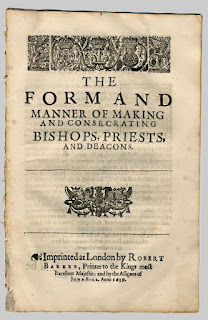
Protestants do intend to confer them both, so far as either Christ did confer them, or the blessed Apostles execute them ... He who saith, "Take thou authority to exercise the office of a Priest in the Church of God" (as the Protestant consecrators do), doth intend all things requisite to the Priestly function, and amongst the rest, to offer a
representative Sacrifice, to commemorate and to apply the Sacrifice which Christ made upon the Cross ...
He who saith, "Whose sins thou dost remit they
are remitted, whose sins thou dost retain are retained" (which are the very words used in the Protestants' Form
of Ordination ), surely intends to confer a power to remit sins. We acknowledge, that he who is ordained, is enabled
by his office many ways to put away sins. 1. By Baptism, "I believe one Baptism for the remission of sins", so saith the Creed. 2. By the Sacrament of the Lord's Supper; “ This is My blood, which is shed for you and for many", so said our Saviour. 3. By prayer, "Call for the presbyters of the Church; the prayer of faith shall save the sick; and if he have committed sins, they
shall be forgiven him" 4. By preaching the word of reconciliation, "God was in Christ, reconciling the world unto Himself, not imputing their trespasses unto them; and
hath committed unto us the word of reconciliation" 5. By
special absolution, "Whose sins ye remit, they are remitted".
I'm not tring to stir the pot and I know it's not your job to catechize a RCCer in Anglican ordination theology, but how do discussions like this above where it sounds like the Anglican Church is giving new powers to individuals (absolution and consecrating) square with other comments on holy orders? Here it sounds like an essential change has occurred in the individual after ordination such that they now have the ability to do things that they could not before ordination.
ReplyDeletePreviously you have quoted writers who like this:
"...the difference that is between the priest and the layman in this matter, is only in the ministration; that the priest, as a common minister of the church, doth administer and distribute the Lord's Supper unto other, and other receive it at his hands (A Defence of the True and Catholic Doctrine of the Sacrament, Book V.11)."
This quote makes it sound like the priesthood is not a change of essence, but rather one of affirmation or authorization (i.e. pre-ordination all have the same power, but just not to do it in the name of the Church). Similar to how in my private life I have the ability write a check, but I can't write a check in the name of "XYZ corporation" until I'm hired/authorized/commissioned as an authorized check writer for "XYZ corporation." Is it just a question of what would it mean for me to use my inherent power of absolution/consecration in my name ("I absolve you in the name of raitchi2")?
Thanks for your perspective,
raitchi2
Hi, many thanks for your comment and question. Bramhall, like other Anglican authors, tends to couch the matter in terms of 'authority' rather than 'power' or 'essence' - and this, therefore, coheres with Cranmer's words.
DeleteThe Anglican-Orthodox 'Cyprus Agreed Statement' (2006) shows how this understanding has deeper roots:
"Bishops and presbyters do not possess an indelible mark as if ordination were a magical seal granting them personal power to celebrate the Eucharist or any other liturgical action, apart from the ecclesial body ... It is a permanent order of service only in union with the Church and by its discerning authority. Any notion of ‘indelible mark’ would imply that the ordained individual possesses forever this peculiar mark of priesthood ... Such a doctrine absolutizes priesthood and isolates it from the community of the Church.
Priesthood is thereby grossly distorted and its significance greatly overestimated".