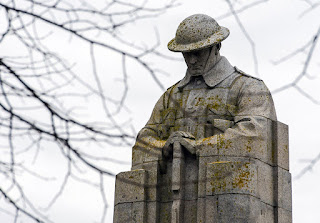
Rachel Mann's description of Remembrance Sunday, in her Fierce Imaginings: The Great War, Ritual, Memory and God of Remembrance Sunday (2017), captures the profundity of this mid-November day. As late Autumn gives way to Winter, Remembrance Sunday is often bleak and cold. This contributes to the day's resonance. It is almost as if the primeval threat and danger of Winter strips away our pretensions and boasts. The fact of mortality hangs in the air, with the trees now bare and Autumn glory past.
It is 'a kind of matins' because the morning office gathers us after sleep to focus afresh on the Permanent Things, on what is Real, with the cold mornings of November reflecting how this awakes us from our spiritual and philosophical slumbers. Remembrance Sunday is akin to this, the themes of sacrifice, love, and death piercing through the delusions and complacency of our culture.
Remembrance Sunday is also one of the very few occasions during which our contemporary culture is confronted with the reality of death. Mann refers to this when she notes how Remembrance Sunday contrasts with early 21st century British customs regarding death. The hushed tones, reverence, and sharpness of Remembrance Sunday are much closer to the Cranmerian funeral rite:
It is striking how modern funerals have assumed the character of celebrations and memorials. The rigorous bleakness of the Book of Common Prayer is too spartan for us. The way silence exposes us to ourselves is too much for us. In the context of mourning and death 'silence' signifies the reality we shall all face - that we too are ultimately dust. It is what will greet us all one day (p.148f).
It is, of course, the "rigorous bleakness" of Cranmer's burial service which draws us to and enables us to behold the hope of resurrection in Christ, removing all vain hopes in order that the true hope may be seen in its glory.
The Church, then, should be seeking to maintain the "rigorous bleakness" of Remembrance Sunday, a cultural event during which we are - almost uniquely in contemporary society - confronted with the profundity of death, love, sacrifice. Mann again powerfully captures this when she describes how Remembrance Sunday spoke to her in childhood: "a ritual speaking into transcendence and vice versa ... finding communion in a cold November ritual".
Silence before the memory of death, sacrifice, and love, the experience of the transcendent sharply cutting through the distractions of our contemporary culture, is - to use language earlier generations of Anglicans used without embarrassment - 'natural religion'. Ordering this towards and showing its fulfillment in Christ, who is the Alpha and Omega, should be a fundamental part of the Church's mission, particularly for those national churches in the Anglican tradition with a vocation to and historic experience of cultural presence.
The natural religion of Remembrance Sunday needs to hear 'through Jesus Christ our Lord'. It needs to hear the Scriptures proclaiming the hope of the Peaceable Kingdom. It needs to hear 'God grant to the living grace, to the departed rest, to the Church, the Queen, the Commonwealth and all people, unity, peace and concord, and to us and all God’s servants, life everlasting'. This needs to be heard so that our cultural memory of death, sacrifice, and love may be ordered towards the beatific vision through the Cross and Resurrection of Jesus Christ. Perhaps "a kind of matins" can then be caught up more fully in the Church's praise and prayer in hope of the resurrection of the body and the life everlasting. Amen.
Comments
Post a Comment