"Substance of our flesh": why 2nd February should be celebrated as a Marian feast

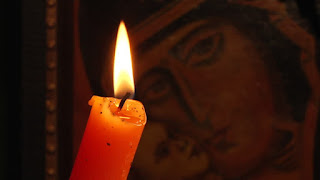
On 23rd January, the parish in which I serve celebrated its monthly Choral Evensong and anticipated Candlemas with music, readings, and prayers from today's feast.  The liturgical purist in me was, of course, somewhat sceptical when the suggestion was first made.  It was, however, a very meaningful way - on a dark, cold January evening - to emphasise the significance to the Epiphany season of the feast of the Purification of Saint Mary the Virgin.

It became, in a way, an Evensong of Our Lady during Epiphanytide, with the Magnificat (Stanford in G) and the anthem, 'When to the temple Mary went', beautifully celebrating the role of the Blessed Virgin.  This was a fitting recognition of the Marian dimension of Epiphanytide in the traditional one year Eucharistic lectionary. The Blessed Virgin is found in the Gospel readings for the Epiphany, the First Sunday after the Epiphany (the finding in the Temple), and the Second Sunday after the Epiphany (the Miracle at Cana). Epiphanytide no less than Christmastide has a Marian dimension worthy of celebration and contemplation.

This has a profound Christological significance, indicated by the saying of the Athanasian Creed at Mattins on the feast of the Epiphany itself:

and Man, of the Substance of his Mother, born in the world.

The glory witnessed to in the Gospel readings of the Sundays of Epiphanytide (whether in the one or three year lectionary) is revealed in the flesh of the Incarnate Word, flesh "of the Substance of his Mother".  The glory manifested at the Lord's Baptism, in the Miracle at Cana, in the signs and wonders in Galilee, is the glory of the Lord manifested in the flesh assumed in the womb of the Blessed Virgin.  Thus, when we praise God in the traditional proper preface for the Epiphany (here from the Canadian BCP 1962), we rejoice that the Eternal Word reveals His glory in the substance of our mortal flesh because He is substance of her flesh:

Through Jesus Christ our Lord, who, in substance of our mortal flesh, manifested forth his glory, that he might bring us out of darkness into his own marvellous light. Therefore with Angels, etc.

This also has relevance when we consider Epiphanytide as a season which draws together Christmastide and the forthcoming Paschal cycle of Lent, Holy Week and Easter.  The One who fasts and is tempted in the wilderness, whose body is anointed by the woman in preparation for His burial, who weeps at the tomb of Lazarus, who experiences agony in the Garden, who is scourged and pierced, dies and is buried, who rises again on the third day is the Eternal Word who has assumed flesh in the womb of the Blessed Virgin.  In other words, Epiphanytide prepares us year by year to enter into the mystery of the Lord's Passion by pointing us to the truth that He "in substance of our mortal flesh, manifested forth his glory".  The glory of the Eternal Word revealed "in substance of our mortal flesh" at the Adoration of the Magi, in the River Jordan, at Cana, in the miracles performed in Galilee, is the glory which will be revealed "in substance of our mortal flesh" in the Cross and Resurrection.

It is Epiphanytide which prepares us for this.  And it does so by means of a deeply Marian dimension: "and Man, of the Substance of his Mother, born in the world". This is why Candlemas, the feast which draws Epiphanytide to a close, is rightly to be regarded as a Marian feast, celebrating the the reality and fullness of the Incarnation as we prepare to turn towards the Paschal Mysteries. It is only in light of the reality and fullness of the Incarnation that we can grasp the salvific truth of the Cross and Resurrection - and this means confessing the Marian dimension, "And was incarnate by the Holy Ghost of the Virgin Mary".

Describing today's feast, after Cranmer, as the Purification of Saint Mary the Virgin - that is, celebrating it as a Marian feast - points to and helps to secure the Christological truth which is at the heart of the Paschal Mystery, to which we now turn.  Denying this Marian title for the feast (as is also the case with the feast of the Annunciation of the Blessed Virgin Mary) obscures the truth of the Incarnation, the truth that requires us to name the Blessed Virgin Mary and so to rejoice that the Eternal Word assumed substance of our flesh for our redemption because He is substance of her flesh.

Comments

Popular posts from this blog

Why I support the ordination of women: a High Church reflection

A number of commenters on this blog have asked about my occasional expressions of support for the ordination of women to all three orders.  With some hesitation, I have decided to post a summary of my own views on this matter.  The hesitation is because I have sought on this blog to focus on issues and themes which can unify those who identify with or have respect (grudging or otherwise!) for what we might term 'classical' Anglicanism (the Anglicanism of the Formularies and - yes - of the Old High Church tradition).  Some oppose the ordination of women (and I have friends and colleagues who do so, Anglo-Catholic, High Church, and Reformed Evangelical).  Some of us support it (again, friends and colleagues covering a wide range of theological traditions). Below, I have organised my thinking around 5 points (needless to say, no reference to Dort is implied). 1. The Declaration for Subscription required of clergy in the Church of Ireland states: (6) I promise to submit ...

How the Old High tradition continued

Charles Gore's 1914 letter to the clergy of his diocese, ' The Basis of Anglican Fellowship ', can be regarded as a classical expression of the Prayer Book Catholic tradition.  A key part of the letter - entitled 'Romanizing in the Church of England' - addressed the "Catholic movement", questioning beliefs and practices within it which tended to "a position which makes it very difficult for its extremer representatives to give an intelligible reason why they are not Roman Catholics".  Gore provides the outlines of an alternative account and experience of catholicity within Anglicanism, defined by three characteristics.  What is particularly interesting about these characteristics is their continuity with the older High Church tradition.  Indeed, the central characteristic as set out by Gore was integral to High Church claims over centuries: To accept the Anglican position as valid, in any sense, is to appeal behind the Pope and the authority of t...

Pride, progressive sectarianism, and TEC on Facebook

Let me begin this post with an assumption that will be rejected by some readers of laudable Practice , but affirmed by other readers. Observing Pride is an understandable aspect of the public ministry of TEC.  On previous occasions , I have rather robustly called for TEC to be much more aware and respectful of the social conservatism of the Red states and regions in which it ministers. A failure to do so risks TEC declining yet further into the irrelevance of progressive sectarianism.  At the same time, TEC also obviously ministers in deep Blue states and metropolitan areas - and is the only Mainline Protestant tradition in which a majority of its members vote Democrat .* With Pride now an established civic commemoration, particularly in such contexts, there is a case for TEC affirming those aspects of Pride - the dignity of gay men and lesbian women, their contribution to civic life, and their place in the church's life - which cohere with a Christian moral vision. (I will n...