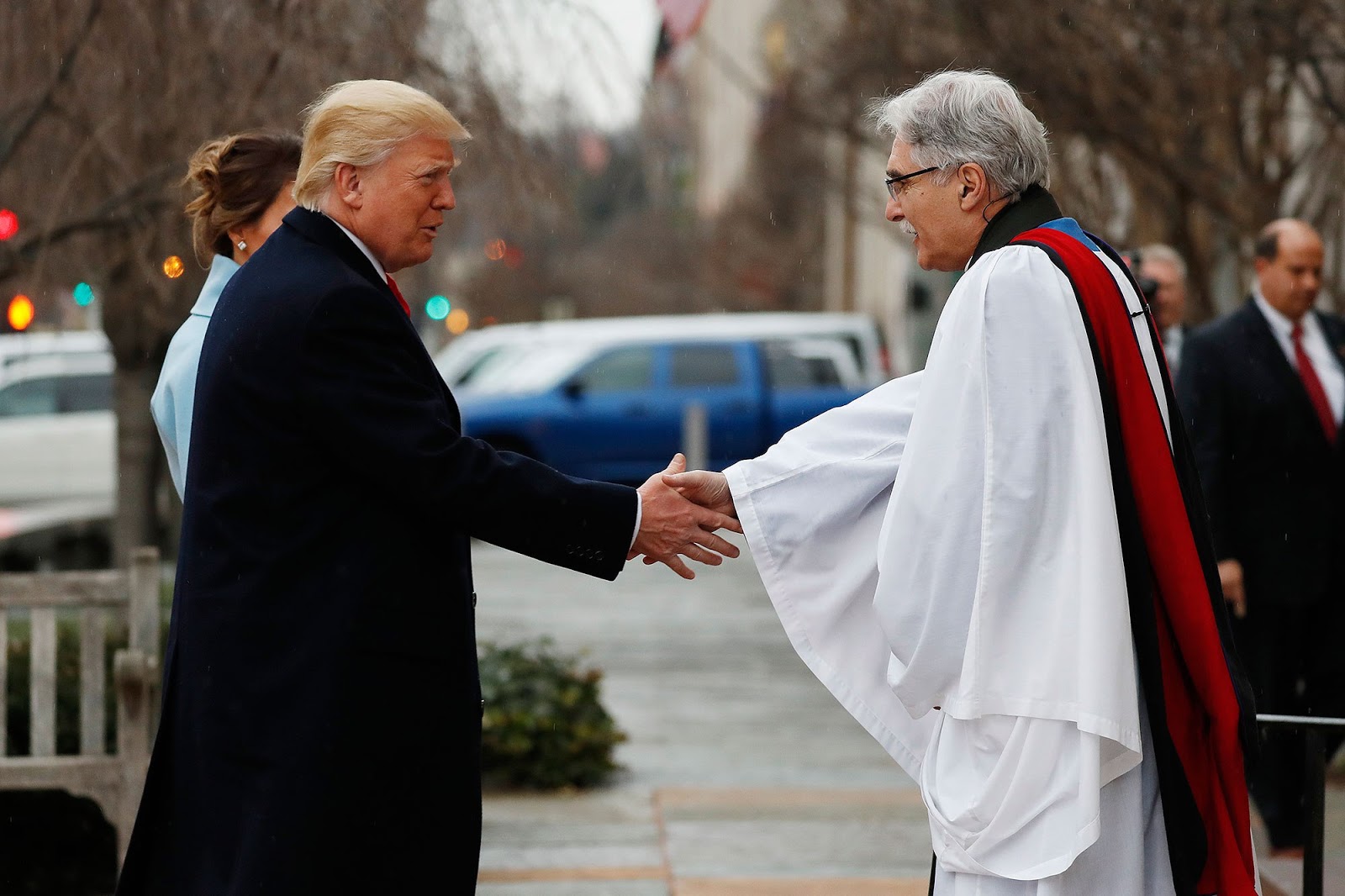
The truth is not in President Trump as far as I can tell, and that is why, it grieves me to say, I would not give him Communion.
To be clear, this is a priest with no pastoral relationship with Donald Trump. And, in fact, a priest who it seems is unlikely to ever be in the situation of administering Holy Communion to Donald Trump. At the beginning of the post he mentions Episcopal churches which Trump occasionally attends. This priest, however, presumes to know what the clergy in those churches should do, despite not having their pastoral responsibilities or pastoral knowledge.
The post does quote the disciplinary rubrics in BCP 1979. Let's leave aside for the moment the admission that "for a priest to refuse anyone Holy Communion is not only unusual but practically unheard of". Consider the first rubric:
If the priest knows that a person who is living a notoriously evil life
intends to come to Communion, the priest shall speak to that person
privately, and tell him that he may not come to the Holy Table until he
has given clear proof of repentance and amendment of life.
Now we can turn to that admission that excluding people from the Sacrament is "practically unheard of" in TEC. This is but a symptom of a wider breakdown of sacramental discipline. Consider the account given by John Henry Newman in a sermon from 1842 of what was typical Anglican practice:
First, we are warned against secret sin, and called to self-examination; a week's preparation follows; then, when the time of celebration is come, we hear the Commandments read, we are solemnly exhorted to put off every thing which may offend God; we confess our sins and our deep sorrow for them.
This discipline has been abandoned in favour of the froth of the Parish Communion movement. In the words of Michael Ramsey:
The awe in the individual's approach to Holy Communion which characterized both the Tractarians and the Evangelicals of old, stands in contrast to the ease with which our congregations come tripping to the altar week by week.
What Taylor termed "devout and periodical Communion" has been replaced with the expectation that all partake of weekly Communion; the longer Exhortations are unheard of, including the call to avail of the benefit of absolution, together with spiritual counsel and advice; the Catechism's teaching - Q. What is required of them who come to the Lord's Supper? A. To examine themselves - is unheeded; contemporary Anglican Eucharistic liturgies lack the solemn invitation, Ye that do truly and earnestly repent of your sins, and are in love and charity with your neighbours; the place of penitence in the Eucharistic rite has been challenged by a generation of Anglican liturgists; and a not insignificant grouping within TEC opposes (and does not abide by) the requirement that one be baptised before partaking of the Holy Communion.
In light of this near complete rejection of traditional Anglican sacramental discipline, the question surely must be asked why a priest in TEC would consider it prudent or necessary to propose the restoration of the very last restort in that discipline, while entirely overlooking the normal practices on which it relies, the normal practices which would renew and sustain the expectation of approaching the Sacrament with "lively faith".
A post from a priest who will never be in a position to administer Holy Communion to President Trump declaring that he would refuse to administer Holy Communion to President Trump is cheap grace. A priest renews sacramental discipline not by publicly declaring what he or she might do in another parish attended by the President, but through the quiet, hard, unglamorous work of teaching and catechesis in the parish in which they serve, restoring traditional Anglican practices in preparation for the Sacrament, and thoughtfully sharing with others the theological, liturgical and pastoral basis for this.
One final thought, shared only half in jest.
If a priest of a parish occasionally attended by President Trump does have concerns about the President's spiritual state in relation to receiving the Sacrament, regular Choral Mattins might be the answer.
Comments
Post a Comment