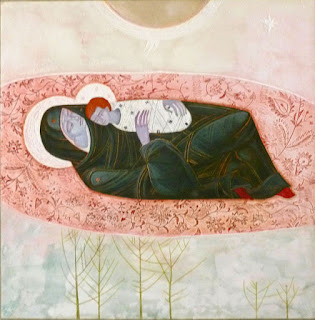
Cohabitation with mystery

Mary, having first changed her joy into wonder, turned her wonder into entertainments of the mystery, and the mystery into a fruitition and cohabitation with it: for "Mary kept all these sayings, and pondered them in her heart".

Jeremy Taylor The Great Exemplar I.IV.7.

(The icon of the Theotokos and Christ Child is by Ulyana Tomkevych.)

Comments

Popular posts from this blog

Why I support the ordination of women: a High Church reflection

A number of commenters on this blog have asked about my occasional expressions of support for the ordination of women to all three orders.  With some hesitation, I have decided to post a summary of my own views on this matter.  The hesitation is because I have sought on this blog to focus on issues and themes which can unify those who identify with or have respect (grudging or otherwise!) for what we might term 'classical' Anglicanism (the Anglicanism of the Formularies and - yes - of the Old High Church tradition).  Some oppose the ordination of women (and I have friends and colleagues who do so, Anglo-Catholic, High Church, and Reformed Evangelical).  Some of us support it (again, friends and colleagues covering a wide range of theological traditions). Below, I have organised my thinking around 5 points (needless to say, no reference to Dort is implied). 1. The Declaration for Subscription required of clergy in the Church of Ireland states: (6) I promise to submit ...

How the Old High tradition continued

Charles Gore's 1914 letter to the clergy of his diocese, ' The Basis of Anglican Fellowship ', can be regarded as a classical expression of the Prayer Book Catholic tradition.  A key part of the letter - entitled 'Romanizing in the Church of England' - addressed the "Catholic movement", questioning beliefs and practices within it which tended to "a position which makes it very difficult for its extremer representatives to give an intelligible reason why they are not Roman Catholics".  Gore provides the outlines of an alternative account and experience of catholicity within Anglicanism, defined by three characteristics.  What is particularly interesting about these characteristics is their continuity with the older High Church tradition.  Indeed, the central characteristic as set out by Gore was integral to High Church claims over centuries: To accept the Anglican position as valid, in any sense, is to appeal behind the Pope and the authority of t...

'Whether the Lutheran Churches have right Ordinations and perfect succession of Bishops': Jeremy Taylor, 'Episcopacy Asserted', and Lutheran orders

Amidst the bitter controversies over episcopacy in the Three Kingdoms during the early 1640s, controversies which had become war in Scotland in 1637 and then in England in 1642, Jeremy Taylor wrote his Laudian defence of episcopal order, The Sacred Order and Offices of Episcopacy Asserted and Maintained . He proposed in this work that the non-episcopal Reformed churches could have had episcopally-ordered clergy: Those good people might have had order from the bishops of England or the Lutheran churches, if at least they thought our churches catholic and Christian. Leaving aside the reality that, for example, French Protestants would have been placed in an invidious political position if they had done as Taylor proposed, it is the reference to "the Lutheran churches" which is significant.  To begin with, a large portion of the Lutheran churches - those in the German lands - were governed by a system of superintendency. It is almost inconceivable that Taylor was not aware of th...