"Ordination is instituted by Christ": Bramhall on the grace of holy orders

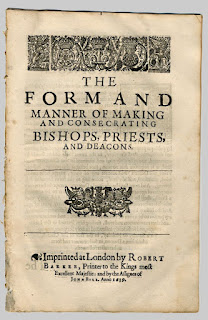
From Bramhall's Protestants' Ordinations Defended, a description of what he calls elsewhere "the grace of holy Orders". He begins by noting how the Church of England regards Holy Orders as instituted by Christ; that the Anglican ordination rite embodied this belief; that it was a theology and practice shared with the Churches of the East; and that, while the Tridentine formula and porrectio instrumentorum were entirely unnecessary, their substance regarding the Eucharistic sacrifice was to be found in the Anglican ordination rite.

They teach, that Ordination is a Sacrament; and we do not much oppose it. It is either weakness or frowardness, to wrangle about the name, when men agree upon the thing. We do believe, that Ordination is a sacred rite or action instituted by Christ, wherein, by the imposition of hands, the holy Orders of Bishops, Priests or Presbyters, and Deacons, are conferred ...

Neither do we say this only, but we prove it manifestly. First, by the institution itself; which was most solemnly performed by Christ, and is most punctually related by the Evangelist. There we have the very matter and the very form used by the Church of England; but of their patin or chalice, or the delivery of it, or of their formal words, "Receive power to offer sacrifice for the living and for the dead", of their new matter and new form, not one syllable. 

Secondly, we produce the belief and practice of the primitive Church, who knew no other matter than imposition of hands, nor other form than, "Receive the Holy Ghost, whose sins thou dost remit they are remitted" ...

Thirdly, we produce the practice of the Greek and all other Churches which are not of the communion, ever until this day; which would not have failed so universally, so constantly, ever since the beginning of Christianity, in an essential of Ordination. And although the Greeks do not receive this new matter and form, yet the Romanists did never deny them to have true Orders, nor did ever ordain any one again who had formerly been ordained in the Church of Greece. How can they admit the Grecians, wanting their new matter and form, to have holy Orders, and yet for the want of these deny the holy Orders of the Protestants to be valid? ...

Fourthly, we produce a great cloud of witnesses from among themselves, of their choicest scholars, and such as have been most conversant in this question, who deny the delivery of the patin and chalice to be essentials of Ordination. 

Lastly, supposing that ceremony to be essential to Ordination, but denying that it is so, yet we have words sufficient in our form to include it; as, "Receive power to exercise the office of a Priest". He that gives the foundation, gives all power pertaining to it. Again, "Receive power to administer the Holy Sacraments". For all the essentials of their Sacrifice are contained in our celebration of the Holy Eucharist; that is, according to their schools, the consecration, and consumption of the whole. Both these we have as well as they: the former more purely than they, the latter more eminently than they; inasmuch as with us both Priest and people do receive, with them the Priest only. 

Comments

Popular posts from this blog

Why I support the ordination of women: a High Church reflection

A number of commenters on this blog have asked about my occasional expressions of support for the ordination of women to all three orders.  With some hesitation, I have decided to post a summary of my own views on this matter.  The hesitation is because I have sought on this blog to focus on issues and themes which can unify those who identify with or have respect (grudging or otherwise!) for what we might term 'classical' Anglicanism (the Anglicanism of the Formularies and - yes - of the Old High Church tradition).  Some oppose the ordination of women (and I have friends and colleagues who do so, Anglo-Catholic, High Church, and Reformed Evangelical).  Some of us support it (again, friends and colleagues covering a wide range of theological traditions). Below, I have organised my thinking around 5 points (needless to say, no reference to Dort is implied). 1. The Declaration for Subscription required of clergy in the Church of Ireland states: (6) I promise to submit ...

How the Old High tradition continued

Charles Gore's 1914 letter to the clergy of his diocese, ' The Basis of Anglican Fellowship ', can be regarded as a classical expression of the Prayer Book Catholic tradition.  A key part of the letter - entitled 'Romanizing in the Church of England' - addressed the "Catholic movement", questioning beliefs and practices within it which tended to "a position which makes it very difficult for its extremer representatives to give an intelligible reason why they are not Roman Catholics".  Gore provides the outlines of an alternative account and experience of catholicity within Anglicanism, defined by three characteristics.  What is particularly interesting about these characteristics is their continuity with the older High Church tradition.  Indeed, the central characteristic as set out by Gore was integral to High Church claims over centuries: To accept the Anglican position as valid, in any sense, is to appeal behind the Pope and the authority of t...

Pride, progressive sectarianism, and TEC on Facebook

Let me begin this post with an assumption that will be rejected by some readers of laudable Practice , but affirmed by other readers. Observing Pride is an understandable aspect of the public ministry of TEC.  On previous occasions , I have rather robustly called for TEC to be much more aware and respectful of the social conservatism of the Red states and regions in which it ministers. A failure to do so risks TEC declining yet further into the irrelevance of progressive sectarianism.  At the same time, TEC also obviously ministers in deep Blue states and metropolitan areas - and is the only Mainline Protestant tradition in which a majority of its members vote Democrat .* With Pride now an established civic commemoration, particularly in such contexts, there is a case for TEC affirming those aspects of Pride - the dignity of gay men and lesbian women, their contribution to civic life, and their place in the church's life - which cohere with a Christian moral vision. (I will n...