
'Maintaining a communion both with the Western and Eastern Churches': Bramhall and Laudianism 's catholic vision
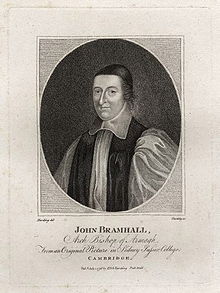
John Bramhall (then Bishop of Derry, Archbishop of Armagh 1661-63), responding to a Roman Catholic apologist who claimed that the Anglican episcopate ("the Protestant Bishops") had abandoned the communion of the Catholic Church:

I deny, that the Protestant Bishops did "revolt from the Catholic Church". Nay, they are more Catholic Bishops in that, than the Roman Catholics themselves; maintaining a communion, for the foundations and principles of Christian religion, both with the Western and Eastern Churches, whom the Church of Rome excommunicates from the society of the mystical Body of Christ, limiting the Church to Rome and such places as depend upon it, as the Donatists did of old to Africa. It is true, the Protestants separated themselves from the communion of the Roman Church; yet not absolutely, nor in such fundamentals and other truths as she retains, but respectively, in her errors, superstructions, and innovations. And they left it with the same mind, that one would leave his father's or his brother's house, when it is infected with the plague: with prayers for their recovery, and with desire to return again, so soon as it is free, and that may be done with safety (Protestants' Ordinations Defended, IV.2).

Bramhall's response reflects how Laudianism cohered with an earlier Conformist understanding of the Church of Rome as a church in error rather than as the anti-Christ.  This also, as seen in the declaration of James VI/I, provided an opening for the hope of the restoration of the unity of the Western Church through, on the one hand, a process of reform in the Roman Church (with somes hopes that this was seen in Gallicanism and Jansenism) and, on the other, a recognition of the See of Rome as patriarch of the West. As such, we might identify this as an antecedent for later ecumenical encounters between Anglicanism and Roman Catholicism, beginning with the Malines Conversations and intensifying after the Second Vatican Council. In particular, Bramhall's insistence that the separation of the ecclesia Anglicana from the Roman Church was "not absolutely, nor in such fundamental and other truths as she retains" has an echo in what Archbishop Michael Ramsey and Pope Paul VI described in their 1966 Declaration as "the ancient common traditions".

No less significant for the Laudian catholic vision which Bramhall articulates, is his statement of the episcopate of the ecclesia Anglicana sharing in the apostolic faith professed by West and East: a vision, we might say, of the Church breathing with 'both lungs'. This 'looking East' has been a significant part of Anglican self-understanding, consistently pointing to the Churches of the East - in their profession of patristic orthodoxy, their life as episcopal, national churches rejecting papal jurisdiction, with married clergy and communion in both kinds, and not accepting Roman dogmatic definitions - as demonstrating that the non-papal, patristic Catholicism of the reformed ecclesia Anglicana (and of the other episcopal, liturgical, sacramental Churches of the Northern Kingdoms) was no innovation.

Bramhall, in other words, powerfully reminds us that Laudianism was not English ecclesial nationalism, opposed to internationalist Puritan and Papalist alternatives.  No, Laudianism evoked a rich vision of the Church Catholic in an age of division: separated from Rome yet sharing with it, in the words of Hooker, "that which is ancienter and better"; and confessing with the East the non-papal Catholic faith of the patristic churches.

Comments

Popular posts from this blog

Why I support the ordination of women: a High Church reflection

A number of commenters on this blog have asked about my occasional expressions of support for the ordination of women to all three orders.  With some hesitation, I have decided to post a summary of my own views on this matter.  The hesitation is because I have sought on this blog to focus on issues and themes which can unify those who identify with or have respect (grudging or otherwise!) for what we might term 'classical' Anglicanism (the Anglicanism of the Formularies and - yes - of the Old High Church tradition).  Some oppose the ordination of women (and I have friends and colleagues who do so, Anglo-Catholic, High Church, and Reformed Evangelical).  Some of us support it (again, friends and colleagues covering a wide range of theological traditions). Below, I have organised my thinking around 5 points (needless to say, no reference to Dort is implied). 1. The Declaration for Subscription required of clergy in the Church of Ireland states: (6) I promise to submit ...

How the Old High tradition continued

Charles Gore's 1914 letter to the clergy of his diocese, ' The Basis of Anglican Fellowship ', can be regarded as a classical expression of the Prayer Book Catholic tradition.  A key part of the letter - entitled 'Romanizing in the Church of England' - addressed the "Catholic movement", questioning beliefs and practices within it which tended to "a position which makes it very difficult for its extremer representatives to give an intelligible reason why they are not Roman Catholics".  Gore provides the outlines of an alternative account and experience of catholicity within Anglicanism, defined by three characteristics.  What is particularly interesting about these characteristics is their continuity with the older High Church tradition.  Indeed, the central characteristic as set out by Gore was integral to High Church claims over centuries: To accept the Anglican position as valid, in any sense, is to appeal behind the Pope and the authority of t...

'Whether the Lutheran Churches have right Ordinations and perfect succession of Bishops': Jeremy Taylor, 'Episcopacy Asserted', and Lutheran orders

Amidst the bitter controversies over episcopacy in the Three Kingdoms during the early 1640s, controversies which had become war in Scotland in 1637 and then in England in 1642, Jeremy Taylor wrote his Laudian defence of episcopal order, The Sacred Order and Offices of Episcopacy Asserted and Maintained . He proposed in this work that the non-episcopal Reformed churches could have had episcopally-ordered clergy: Those good people might have had order from the bishops of England or the Lutheran churches, if at least they thought our churches catholic and Christian. Leaving aside the reality that, for example, French Protestants would have been placed in an invidious political position if they had done as Taylor proposed, it is the reference to "the Lutheran churches" which is significant.  To begin with, a large portion of the Lutheran churches - those in the German lands - were governed by a system of superintendency. It is almost inconceivable that Taylor was not aware of th...