'Is the Lord sensibly present there?': Cosin against Pusey on adoration of the sacrament

Continuing his critique of Pusey in The Teaching of the Anglican Divines in the Time of King James I and King Charles I on the Doctrine of the Holy Eucharist (1858), Henry Charles Groves - a clergyman of the Church of Ireland - addresses the "simple question" raised by Pusey:

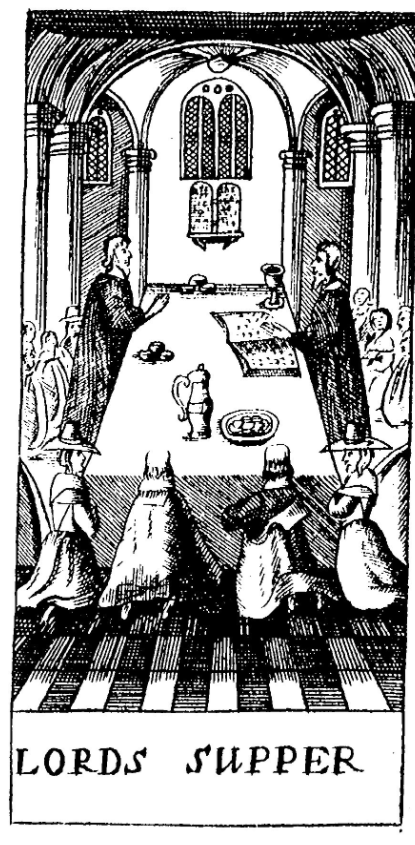
But with Dr. Pusey, "the simple question is, 'is our Lord and God present there?'" He must indeed be simple that would allow that. It certainly is the simple question with the Romanists, when defending themselves against the attacks which their Protestant assailants make on them. But the simple question with Anglican divines was, "Is the Lord sensibly present there?" It was thus Cosin argued. 

Groves quotes from Cosin's Notes on the Book of Common Prayer, in which - as with Andrewes - a thoroughly Reformed understanding of the Eucharist is evident:

True it is that the Body and Blood of Christ are Sacramentally and really (not feignedly) present, when the blessed Bread and Wine are taken by the faithful communicants ... Yet because that Body and Blood is neither sensibly present, (nor otherwise at all present but only to them that are duly prepared to receive them, and in the very act of receiving them and the consecrated elements together, to which they are sacramentally in that act united,) the adoration is then and there given to Christ Himself, neither is nor ought to be directed to any external sensible object, such as are the blessed elements. But our kneeling, and the outward gesture of humility and reverence, is ordained only to testify and express the inward reverence and devotion of our souls towards our blessed Saviour, who vouchsafed to sacrifice Himself for us upon the Cross, and now presenteth Himself to be united sacramentally to us, that we may enjoy all the benefits of His mystical Passion, and be nourished with the spiritual food of His blessed Body and Blood unto life eternal.

Note how Cosin here affirms three key Reformed convictions. Firstly, the Lord is present "only to them that are duly prepared to receive". Secondly, the sacramental union between bread, cup, and the Body and Blood of the Lord is limited to "the very act of receiving them". And, thirdly and crucially, "that Body and Blood is neither sensibly present", for we partake of Christ - as Article 28 affirms - "only after an heavenly and spiritual manner". This being so, adoration cannot and should not "be directed to ... the blessed elements".

Cosin, in other words, definitively answered Pusey's simplistic question.


Comments

Popular posts from this blog

Why I support the ordination of women: a High Church reflection

A number of commenters on this blog have asked about my occasional expressions of support for the ordination of women to all three orders.  With some hesitation, I have decided to post a summary of my own views on this matter.  The hesitation is because I have sought on this blog to focus on issues and themes which can unify those who identify with or have respect (grudging or otherwise!) for what we might term 'classical' Anglicanism (the Anglicanism of the Formularies and - yes - of the Old High Church tradition).  Some oppose the ordination of women (and I have friends and colleagues who do so, Anglo-Catholic, High Church, and Reformed Evangelical).  Some of us support it (again, friends and colleagues covering a wide range of theological traditions). Below, I have organised my thinking around 5 points (needless to say, no reference to Dort is implied). 1. The Declaration for Subscription required of clergy in the Church of Ireland states: (6) I promise to submit ...

How the Old High tradition continued

Charles Gore's 1914 letter to the clergy of his diocese, ' The Basis of Anglican Fellowship ', can be regarded as a classical expression of the Prayer Book Catholic tradition.  A key part of the letter - entitled 'Romanizing in the Church of England' - addressed the "Catholic movement", questioning beliefs and practices within it which tended to "a position which makes it very difficult for its extremer representatives to give an intelligible reason why they are not Roman Catholics".  Gore provides the outlines of an alternative account and experience of catholicity within Anglicanism, defined by three characteristics.  What is particularly interesting about these characteristics is their continuity with the older High Church tradition.  Indeed, the central characteristic as set out by Gore was integral to High Church claims over centuries: To accept the Anglican position as valid, in any sense, is to appeal behind the Pope and the authority of t...

1928 practices and the 1979 book: unthinking conservatism or popular piety?

Those responsible for Earth & Altar - a new blog emanating from a group within TEC - are to be congratulated for an excellent contribution to wider Anglican discussion and debate. The commitment to "an expansively conceived credal orthodoxy as fully compatible with LGBTQ inclusion, gender equality, and racial justice" is an important part of a wider retrieval of creedal orthodoxy within what we might call the post-liberal generation. It is in this spirit that I want to respond to a recent post on the site by Andrew McGowan , Dean of the Berkeley Divinity School at Yale and Professor of Anglican Studies at Yale Divinity School.  Against the background of another round of "ill-defined" liturgical revision in TEC, he understandably urges that a fuller reception of the 1979 BCP should occur before further reforms. In doing so, however, he takes aim at what he describes as "clinging to the ritual structures of 1928" while using the text of 1979.  We ...