Posts

Showing posts with the label Absolution

'In the Greek Church': Looking East with Ussher

Image
As Ussher continued to reflect on 'the priest's power to forgive sins', he looked towards the East. He pointed to two examples from the liturgies of the East to demonstrate that this power directly belongs only to God: Add hereunto the prayer of Damascen, which is still used in the Greek Church before the receiving of the Communion: "Lord Jesus Christ, our God, who alone hast power to forgive sins, in thy goodness and loving-kindness pass by all the offences of thy servant, whether done of knowledge or of ignorance, voluntary or involuntary, in deed or word, or thought; and that which is used after, in the Liturgy ascribed to St James, wherewith the priest shutteth up the whole service: "I beseech thee, Lord God, hear my prayer in the behalf of thy servants, and as a forgetter of injuries pass over all their offences. Forgive them all their excess, both voluntary and involuntary: deliver them from everlasting punishment. For thou art he who didst command us, sayin...

'He of his mercy pardon and forgive thee': Taylor's alternative to the indicative form of absolution

Image
On previous occasions, laudable Practice has noted both Jeremy Taylor's critique of the indicative form of absolution ('I absolve thee') and how this was reflected in 18th century High Church caution regarding this form of absolution in the BCP's Visitation of the Sick, as seen in the comments of Secker and others. One of Taylor's most famous works, Holy Dying (1651), demonstrates his desire for a form of absolution in private confession after the declaratory and precatory forms: Then let the sick man be called to rehearse the articles of his faith; or, if he be so weak he cannot, let him (if he have not before done it) be called to say Amen when they are recited, or to give some testimony of his faith and confident assent to them. After which it is proper (if the person be in capacity) that the minister examine him, and invite him to confession, and all the parts of repentance, according to the foregoing rules; after which he may pray the prayer of absolution. O...

'The real meaning of that absolution': Phillpotts on the absolution in the Visitation of the Sick

Image
Having last week considered how Henry Phillpotts, in a series of letters - debating a Roman Catholic apologist - published in 1825, gave voice to an Old High critique of auricular confession, we now turn to this insistence that the special form of absolution in the Visitation of the Sick was not to be understood in the terms of Roman Catholic theology: But it may be said, a particular absolution "is given to him who has made a particular confession": true, it is enjoined in the Rubric, that after what has preceded, if the sick man humbly and heartily desire it, the priest shall absolve him in the form annexed, a form, the meaning of which, if it be ambiguous, must be understood from comparison with the express doctrine, and uniform practice, of our Church in all the preceding instances. But even in this very form there is an implied declaration of the nature of the absolving power; it is given to absolve all sinners who truly repent and "believe in our Lord Jesus Chris...

'Nothing can be more prudent than this reserve': Phillpotts' rejection of auricular confession

Image
In a series of letters published in 1825 , Henry Phillpotts - standing in the Old High tradition, a rector in the Diocese of Durham, soon to be appointed Dean of Chester and, in 1830, Bishop of Exeter - engaged with a Roman Catholic apologist, Charles Butler. The ninth letter addressed the matter of 'Confession and Absolution in the Church of Rome', including a 'Statement of Doctrine and Practice of the Church of England on these points'.  Phillpotts noted that Butler had mischievously and inaccurately used the two references to private confession in the Book of the Common Prayer. There was, Phillpotts declared with right and proper confidence, no comparison between Roman Catholic teaching on the Sacrament of Penance and the Prayer Book's pastoral provision in the Exhortation in the Holy Communion: You know that auricular confession is, with you, an essential part of a Sacrament, which, as you value your soul's salvation, you must perform. You also know, that, w...

'With piety and confidence resign his soul into the hands of God': Jeremy Taylor and the month of the departed

Image
In The Great Exemplar (1649), as Taylor reflects on the Lord's Passion and Death, he provides a discourse entitled 'Of Death, and the due Manner of Preparation to it'. It is appropriate reading for this month of the departed, not least for its reminder that we are always called to be prepared for our death:  And indeed, since all our life we are dying and this minute in which I now write, death divides with me, and hath got the surer part and more certain possession, it is but reasonable that we should always be doing the offices of preparation. Alongside this exhortation to holy living - the "one way of preparing to death" - Taylor also addresses the circumstances of "those days of our last visitation", what the Litany terms "the hour of death". Here he points to the three ministries "at the point of departure", appointed by the Prayer Book : prayer and spiritual counsel, absolution, and reception of the holy Sacrament. While the pr...

Neither required nor encouraged: Lonsdale on private confession and absolution

Image
In the last year of his life, 1867, John Lonsdale, Bishop of Lichfield, had to address one of the most theologically and culturally divisive aspects of Anglo-catholic practice in Victorian England: auricular confession. The promotion of auricular confession, as Nockles notes, was one of the most profound differences between the Old High tradition and the Tractarians: "Forgiveness was effectively made conditional upon the sacramental absolution administered by a priest in private confession in a way which the old High Churchmen deplored". As recorded in The Life of John Lonsdale (1868), the Bishop was required to address the matter because of the controversy surrounding a boys' school in his diocese allowing pupils "by the permission of their parents only, to come to confession, and to receive absolution, if they are unable (as the Prayerbook says) by the usual means to satisfy their own conscience, and require further comfort or advice". Lonsdale carefully defe...

"No countenance to the snare of compulsory auricular confession": Jelf's Bampton Lectures on private confession

Image
In the seventh of his1844 Bampton Lectures,  An inquiry into the means of grace, their mutual connection, and combined use, with especial reference to the Church of England , Jelf - one of the Zs, those whom Nockles highlights as the post-1833 continuation of the Old High tradition - addresses the issue of private confession and absolution. Proposed by Tractarians as a regular, routine feature of the spiritual life, Jelf robustly reaffirms the Old High understanding that this Prayer Book provision must not be regarded as Tridentine "compulsory auricular confession". Jelf begins by pointing to the radical difference between the primitive penitential practice and the much later Sacrament of Penance: And let it be acknowledged that it [i.e. the primitive practice] is now to be found nowhere in Christendom as it existed in the Primitive Church; and, considering the change of circumstances and habits, it is, perhaps, hardly to be expected that any Church will ever succeed in resto...

"To help our infirmities": the Absolution at Morning and Evening Prayer

Image
On this third day of Lent, final words on the Absolution at the daily office from  A Critical and Practical Elucidation of the Morning and Evening Prayer of the Church of England  (1796), by clergyman John Shepherd.  Here Shepherd turns to one of the most beautiful aspects of this Absolution, when it prays for and sets before us the path of restoration and renewal. Hearing these words week by week, receiving them in penitence and faith, is to experience to the restoration of the Prodigal: In the second part of the Absolution the minister proceeds to remind us of the means by which the blessings of pardon and reconciliation may be obtained. He exhorts us, to beseech God to grant us "true repentance," repentance unto salvation, which he alone can give, and "his Holy Spirit," to deliver us from all deadly sin, to help our infirmities, to invigorate our faith, to excite our hope, to purify our hearts, and to engage our obedience. For our encouragement he adds that if we...

"Promulgates the terms of pardon": the Absolution at Morning and Evening Prayer

Image
On this second day of Lent, further words on the Absolution at the daily office from  A Critical and Practical Elucidation of the Morning and Evening Prayer of the Church of England  (1796), by clergyman John Shepherd.  Echoing Hooker's statement that the Absolution "day by day" in "our publick prayers" applies to those whose confession "hath proceeded from a true penitent mind" ( LEP VI.4.15), Shepherd notes the pastoral wisdom in the use of the nominative case in the Absolution: The priest does not absolve in his own name. He simply promulgates the terms of pardon, granted by the Father of our Lord Jesus Christ. That this may be misunderstood by none, is probably one reason, for which our form repeats the nominative case. "He," that is, Almighty God, "pardoneth and absolveth all them that truly repent, and unfeignedly believe his Holy Gospel." Should there in a mixed congregation be any hypocritical worshipper, whose faith is fei...

"To restore them that fall": the Absolution at Morning and Evening Prayer

Image
On this day before Lent, we continue consideration of the Absolution at Morning and Evening Prayer from A Critical and Practical Elucidation of the Morning and Evening Prayer of the Church of England (1796), by clergyman John Shepherd. In his commentary on Prayer Book Mattins and Evensong, Shepherd expounds how the Absolution at the morning and evening offices is an exercise in the presbyteral ministry of reconciliation.  On Shrove Tuesday, Shepherd's words are a reminder there is no need for private absolution (albeit this ministry is available to those who desire it for "quieting of ... conscience, and avoiding of all scruple and doubtfulness"). Those of us who have heard the absolution pronounced at Morning or Evening Prayer on Quinquagesima or the days following, being penitent, have been absolved in preparation for the penitential season.  The Church of England places the Absolution, or Remission of Sins, immediately after the General Confession. The whole congrega...

"Signal promise": the Absolution at Morning and Evening Prayer

Image
As Lent approaches, most of the posts this week will consider the normative way Anglicans over centuries received absolution: that is, by means of "The Absolution or Remission of sins ... pronounced by the Priest" at Mattins and Evensong. To guide our reflections on this Absolution, we turn to  A Critical and Practical Elucidation of the Morning and Evening Prayer of the Church of England (1796), by clergyman John Shepherd. Mindful that the Absolution at Morning and Evening Prayer, "pronounced by the Priest alone", had been a source of Puritan and then Dissenting criticism since the Elizabethan era, Shepherd invokes Calvin in defence of the Absolution as a "signal promise" of forgiveness after confession: The propriety of introducing the Absolution in. this part of our daily service, is acknowledged without reserve by Calvin, whose immense learning, and extraordinary abilities, no one will dispute. This distinguished instrument of the reformation, who was...

"You profess to act in it only as the commissioned ministers of Christ": Bishop Phillpotts' 1842 Visitation Charge and the ministry of private absolution

Image
As part of the series of weekly posts from the responses to Tract XC by Old High bishops in the visitation charges of the early 1840s, today we continue consideration of the charge given in 1842 by Henry Phillpotts (Bishop of Exeter 1831-69). These charges are a rich seam of Old High teaching.  In today's extract Phillpotts addresses a matter which would become a significant point of controversy between Tractarians and Old High: private absolution. Contrary to what would become the Anglo-catholic imitation of the Roman discipline, Phillpotts maintains the caution and reserve of historic Prayer Book practice: rejecting any notion of a necessity for private absolution; no requirement to catalogue any or all sins; and the efficacy of absolution dependent on being received in faith and penitence.  Mindful of the divisive controversies which ensued upon the Tractarian and Anglo-catholic promotion of the Roman discipline, Phillpotts' Old High exposition was deeply Hookerian and of...

"The benefit of absolution": a Laudian view of the absolution at Mattins and Evensong

Image
From Richard Montagu's Articles of Enquiry in the Primary Visitation of the Diocese of Norwich, 1638: an insight into the significance given by the Laudians - and, later, by the Old High tradition - to the Absolution at Mattins and Evensong: Do your parishioners come late to church, and not at the beginning of Divine service, to make their humble confession unto Almighty God? who, by coming late, deprive themselves of the benefit of absolution, and do become unprofitable hearers and petitioners in that holy action ... Doth he use the absolution to be pronounced on penitents, not as it is a declaration of forgivenesse, but as a prayer, altering the words of the Common Prayer-book, as some have presumed to do? (It is worth noting that in addition to 17th century Puritans denying this to be an Absolution, and turning it into a prayer, the Ordinariate has also explicitly done this .)

"No empty or useless ceremony": absolution at Mattins and Evensong

Image
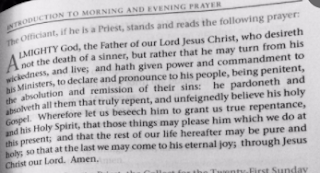
The first lesson at Mattins on Tuesday of last week was Numbers 6, concluding with the blessing to be given by the Aaronic priesthood: "On this wise ye shall bless the children of Israel". Calvin's commentary on this - "And they shall put my name upon the children of Israel, and I will bless them" - applies it to the Church's ordained ministers:  The promise, which is finally subjoined, gives assurance that this was no empty or useless ceremony, when He declares that He will bless the people. And hence we gather, that whatsoever the ministers of the Church do by God’s command, is ratified by Him with a real and solid result; since He declares nothing by His ministers which He will not Himself fulfill and perform by the efficacy of His Spirit. Reading Calvin's words immediately brought to mind those of Cranmer in the absolution at Morning and Evening Prayer: Almighty God, the Father of our Lord Jesus Christ, who desireth not the death of a sinner, but ra...

Bramhall: "They condemn not private confession, and absolution itself"

Image
From Protestants' Ordination Defended - a response to a Roman Catholic critique of Anglican orders - by Bramhall, then Bishop of Derry, addressing the allegation that Anglican formularies had removed private confession and the priestly authority to absolve sins: Neither have the Protestants "pared away" all manner of mariner of shrift, or confession and absolution. I have shewed before in this answer five several ways [he had previously stated that the priestly authority to remit sins was found in administering Baptism, the Eucharist, prayer, preaching, and absolution], whereby the Protestants hold, that their Presbyters put away sins. Nay, they condemn not private confession, and absolution itself, as an ecclesiastical policy, to make men more wary how they offend; so as it might be left free, without tyrannical imposition. No better physic for a full stomach than a vomit. Bodily sores do sometimes compel a man to put off natural shamefacedness, and to offer his less co...

'The Right Way to Safety after Shipwreck': Bramhall on private confession

Image
Bramhall, then Archbishop of Armagh, in a sermon - 'The Right Way to Safety after Shipwreck' - before the Irish House of Commons, June 1661, recommending private confession and absolution: Confession, with its requisites, contrition and amendment of life ... do make a complete repentance: which some Fathers style a "second table after shipwreck", others a "Baptism of pains and tears" ... Thrice happy are they, which use this plank aright, to bring them through the raging billows of this sinful world to the haven of eternal bliss. Confession is as ancient as our first parents, whom God Himself did call to the performance of this duty. It was  practised among the Israelites, by Divine precept; by those  Jews that repaired to the Baptism of John; by those Ephesian converts; prescribed by St. James, "Confess one  to another, and pray one for another" ... There is no better physic for a full stomach, than a vomit; nor for a soul replete with sin, than c...

Ministering the Advent hope at the hour of death

Image
Mindful of the traditional Advent themes of the Four Last Things, it was appropriate that Timothy Stanley's recent interview with Rowan Williams addressed the matter of our deathbed.  In the course of the interview Stanley said, "I would want the Last Rites when I’m dying, and if the hospital sent for the local Anglican cleric, I might not get it, because not every Anglican does it". And, Stanley quite rightly protests, "on my death bed, I would want to know what I’m going to get".   Stanley's critique is not entirely unfair.  There are Anglican clergy - let's call them the neo-Puritans - who think that extemporary prayer and a Bible reading of their choice will suffice at the deathbed. That, however, is weak, pale stuff.  And certainly not the Real Thing. For that we turn to the Book of Common Prayer : Here shall the sick person be moved to make a special confession of his sins, if he feel his conscience troubled with any weighty matter. After which co...

Sunday Mattins: means of grace

Image
The Prayer Book Office has been the principle means of grace for Anglican Christians since the break with Rome - Oikodomeo .  I have previously referred to this phrase from Oikodomeo but it is certainly worthy of further comment as it helps to deliver past generations of Anglicans from - to use a term of the Marxist historian E.P. Thompson - the " enormous condescension of posterity ".  Rather than viewing Sunday Mattins, the mainstay of Anglican public worship from the 16th to the mid-20th century, as a form of deep spiritual impoverishment, Oikodomeo rightly identifies it as a "principle means of grace". In what way was it a "means of grace"? How did Sunday Mattins sustain a vibrant Anglican piety over centuries? If we consider the various constituent parts of the liturgy of Mattins and their meaning, we perhaps can begin to identify how Sunday Mattins functioned as a "means of grace". As laudable Practice has pointed out in the past , th...

"And seek afresh our absolution": how the Ordinariate daily office sides with the Puritans

Image
"Morning and Evening Prayer from the Anglican prayer book tradition." That is how the Ordinariate's new Divine Worship: Daily Office is being advertised.  And, indeed, there is some merit in this, as Oikodomeo has said in an excellent review: DWDO is an ecumenical gift and compliment to the Anglican Communion. The Prayer Book Office has been the principle means of grace for Anglican Christians since the break with Rome. That Rome now not only acknowledges this but encourages this prayer is a celebration of the Anglican gift to the church catholic. Anglicanism is a means to holiness, a gift of grace.  What does give me pause, however, is related to Oikodomeo's entirely correct observation that Mattins and Evensong were "the principle means of grace for Anglican Christians" over centuries.  Part of the reason for this was the fact that these offices included Confession and Absolution.  To put in more explicit terms, the grace of Absolution was experienced i...