Posts

Showing posts with the label Calvin

'Far be it from us that we should receive him for our Master': Nelson's 'Life of Bull' and a Hookerian view of Calvin

Image
In the account provided by Nelson in his 1713 Life of Dr. George Bull , of how Bull's Defensio Fidei Nicaenae (1685) defended "the old Catholick doctrine" of divine monarchy and the Son's subordination - according to Nicene faith - against the assertion of "the Calvinistical School" that the Son is autotheos , we saw last week how Bull's "generous Liberty of Mind" allowed him to approvingly quote Remonstrant thinkers with whom he otherwise disagreed on Trinitarian doctrine. The same "generous Liberty of Mind" Nelson also sees in Bull's approach to Calvin. Bull's rejection of Calvin was robust, regarding the doctrine of autotheos as undermining the fundamentals of Trinitarian teaching. This, however, does not at all result in an outright rejection of Calvin: While I am telling these Things, I have an Horror upon me; and therefore I most seriously exhort the pious and studious Youth, that they take heed of that Spirit from wh...

'The old Catholick Doctrine': Nelson's 'Life of Bull' , divine monarchy, and the Calvinistical School

Image
Last week we saw, from Nelson's 1713 Life of Dr. George Bull , how Bull's Defensio Fidei Nicaenae (1685) asserted a subordination of the Son on the basis on Nicene confession that He is begotten of the Father, "God of God", the Father thus being "the Fountain, Original and Principle of the Divinity". This view of the divine monarchy and the Son's subordination was, of course, controversial, provoking sustained critiques of Bull, despite (as previously noted) divines such as Ralph Cudworth and Jeremy Taylor sharing this understanding. Nelson himself has no hesitation whatsoever in affirming Bull's position, placing it in a wider context of Lutheran and Roman Catholic divines who likewise understood the Nicene Confession, and identifying its opponents as "the Calvinistical School": he hath learnedly and solidly confuted the unreasonable and uncatholick Notion of the Moderns, which maketh the Son a self-dependent Principle of Divinity (and by...

'Through the ministrations of angels': Calvin on Psalm 91

Image
As Michaelmas approaches, words from Calvin's commentary on Psalm 91:11-12 , demonstrating how a lively understanding of the ministry of the angels was present in Reformed thought (as also seen in the writings of Bullinger ): The Psalmist adds, "all your ways" in the plural number, to convey to us more distinctly that wherever we go we may expect that the angels shall always extend their guardianship to us. The course of our life is subject to many windings and changes, and who can tell all the storms by which we are liable to be tossed? It was necessary, therefore, to know that the angels preside over all our particular actions and purposes, and thus to be assured of their safe-conduct in whatever quarter we might be called to move ... "They shall bear thee upon their hands." He gives us a still higher idea of the guardianship of the angels, informing us, that they not only watch lest any evil should befall us, and are on the alert to extend assistance, but bea...

'So great efficacy'': another reason to wish that a certain type of contemporary evangelical Anglican heeded Calvin

Image
Lord God our Father,  through our Saviour Jesus Christ you have assured your children of eternal life and in baptism have made us one with him. Deliver us from the death of sin and raise us to new life in your love, in the fellowship of the Holy Spirit, by the grace of our Lord Jesus Christ. Amen. For some it might be surprising that the post-Communion prayer from the Church of Ireland BCP 2004 - shared with the CofE's Common Worship - for the 'Second Sunday of Easter' (i.e. Low Sunday) can bring us to think about the sacramental theology of Calvin. The issue came to mind when this prayer was said on Sunday past, as I am aware that for a certain strain of contemporary evangelicalism in the CofI this reference to Baptism is, to put it charitably, problematic. (We will leave aside, for the moment, the fact that the subscription required of all clergy in the CofI declares that "the doctrine of the Church of Ireland" as set forth in the Book of Common Prayer is ...

'You must not expect such fruits in a little time': Jeremy Taylor's sermon 'The Invalidity of a Late, or Deathbed Repentance'

Image
Today our Lenten readings from Jeremy Taylor's sermon Golden Grove sermon ' The Invalidity of a Late, or Deathbed Repentance ' draw to a close. And they do so with the figure of the Penitent Thief. Surely this figure contradicts the very point of Taylor's sermon: that deathbed repentance is invalid? This, contends Taylor, is to misunderstand our relationship to the Penitent Thief: But why may not we be saved as well as the thief upon the crosse? even because our case is nothing alike. When Christ dies once more for us, we may look for such another instance; not till then. But this thiefe did but then come to Christ; he knew him not before; and his case was as if a Turk or heathen should be converted to Christianity, and be baptized, and enter newly into the Covenant upon his deathbed. Then God pardons all his sins; and so God does to Christians when they are baptized, or first give up their names to Christ by a voluntarie confirmation of their baptismal vow: but when th...

'The absolute necessity of holy living': Jeremy Taylor's sermon 'The Invalidity of a Late, or Deathbed Repentance'

Image
In this week's reading from ' The Invalidity of a Late, or Deathbed Repentance ', Taylor explicitly sets out "the absolute necessity of holy living", defined by "all those Commandments in Scripture": The second generall consideration is, The necessity, the absolute necessity of holy living, God hath made a Covenant with us, that we must give up our selves, bodies and souls, not a dying, but a living, and healthfull sacrifice. He hath forgiven all our old sins, and we have bargained to quit them, from the time that we first come to Christ, and give our names to him; and to keep all his Commandements. We have taken the Sacramentall oath, like that of the old Romane Militia, we must beleeve, and obey, and do all that is commanded us, and keep our station, and fight against the flesh, the world, and the devil, not to throw away our military girdle, and we are to do what is bidden us, or to die for it, even all that is bidden us, according to our power.  For,...

'From the death of sin to the life of righteousness': Jeremy Taylor's sermon 'The Invalidity of a Late, or Deathbed Repentance'

Image
In last week's Friday Lenten reading from Jeremy Taylor's Golden Grove sermon ' The Invalidity of a Late, or Deathbed Repentance ', we saw how Taylor declared that repentance "consists in the abolition of sins". This week's reading continues from that point, with Taylor declaring "repentance is not only an abolition" (emphasis added). It must also include holy living: repentance is not onely an abolition, and extinction of the body of sin, a bringing it to the altar, and slaying it before God and all the people; but that we must also mingle gold and rich presents, the oblation of good works, and holy habits with the sacrifice, I have already proved: but now if we will see repentance in its stature and integrity of constitution described, we shall finde it to be the one half of all that which God requires of Christians. Faith and Repentance are the whole duty of a Christian. Faith is a sacrifice of the understanding to God: Repentance sacrifices ...

'Repentance consists in the abolition of sins': Jeremy Taylor's sermon 'The Invalidity of a Late, or Deathbed Repentance'

Image
As we continue Friday readings from Jeremy Taylor's Golden Grove sermon ' The Invalidity of a Late, or Deathbed Repentance ' we encounter his proclamation that repentance "consists in the abolition of sins". That is, confession and penitential sorrow alone do not equate to repentance. Repentance must necessarily include a dying to sin: For (they are the words of Saint Paul) they that are Christs have crucified the flesh, with the affections and lusts: the work is actually done, and sin is dead, or wounded mortally, before they can in any sense belong to Christ, to be a portion of his inheritance: And He that is in Christ is a new creature. For in Christ Jesus nothing can avail but a new creature: nothing but a Keeping the Commandements of God: Not all our tears, though we should weep like David and his men at Ziklag, till they could weep no more, or the women of Ramah, or like the weeping in the valley of Hinnom, could suffice, if we retain the affection to any on...

'A deep sorrow, not a superficial sigh': Jeremy Taylor's sermon 'The Invalidity of a Late, or Deathbed Repentance'

Image
Last Friday, we commenced Lenten readings from one of the more controversial of Jeremy Taylor's Golden Grove sermons, ' The Invalidity of a Late, or Deathbed Repentance '. It is too often presented as a Caroline rupture with Reformation thought. The previous post emphasised how such an interpretation did not do justice to Luther and Calvin on repentance, and how Taylor's understanding of repentance cohered with the Reformation. Today's extract continues on this theme. Here Taylor contrasts authentic repentance, "a deep sorrow", with a mere "superficial sigh". Crucially, Taylor insists that repentance must be such a sorrow "must be productive" of both a hatred and a declining of sin: Repentance implies a deep sorrow, as the beginning and introduction of this duty; not a superficiall sigh, or tear, not a calling our selves sinners, and miserable persons; this is far from that godly sorrow that worketh repentance; and yet I wish there were...

Jeremy Taylor's sermon 'The Invalidity of a Late, or Deathbed Repentance': undoing the Reformation?

Image
On the Fridays of Lent, laudable Practice will be posting readings from perhaps one of the more controversial of Jeremy Taylor's Golden Grove sermons, ' The Invalidity of a Late, or Deathbed Repentance '. The accusation that Taylor was here exalting works over faith, and so undoing the Reformation, is significantly flawed. It implies that the Reformation did not take repentance seriously. By contrast, Luther famously proclaimed otherwise in the first of his 95 Theses : When our Lord and Master Jesus Christ said, "Repent", he willed the entire life of believers to be one of repentance. Likewise, Calvin: But lacking any semblance of reason is the madness of those who, that they may begin from repentance, prescribe to their new converts certain days during which they must practice penance, and when these at length are over, admit them into communion of the grace of the gospel. I am speaking of very many of the Anabaptists, especially those who marvelously exult in b...

'The very being and Oeconomy of Christianity is destroyed by these prayers': Jeremy Taylor echoing Calvin against the invocation of Saints

Image
From Jeremy Taylor's  A dissuasive from Popery (1664 & 1667) - which George Rust in the sermon at Taylor's funeral particularly highlighted as among his "several excellent Discourses", this one "receiv'd by a general approbation" - a critique of the invocation of saints: Now therefore we desire it may be considered, That there are as the effects of Christ's death for us, three great products, which are the rule and measure of our prayers, and our confidence; 1. Christ's merits. 2. His Satisfaction. 3. His Intercession. By these three we come boldly to the Throne of Grace, and pray to God through Jesus Christ. But if we pray to God through the Saints too, and rely upon their 1. Merit. 2. Satisfaction. 3. And Intercession; Is it not plain that we make them equal with Christ, in kind, though not in degree? ... And therefore the very being and Oeconomy of Christianity, is destroyed by these prayers; and the people are not, cannot be good Christ...

'An old Calvinistic formula': the sacramental Calvinism of Lancelot Andrewes

Image
How are we to understand the eucharistic theology of Lancelot Andrewes? Since the mid-19th century, the Tractarian suggestion that Andrewes represented a rejection of Reformed sacramental theology has become almost de rigueur within Anglicanism. This being so, the words of Andrewes - here in response to Cardinal Bellarmine - are therefore presented as an alternative to both Reformed and Tridentine eucharistic theologies: For, what the Cardinal is not, unless willingly, ignorant of, Christ said, This is My Body: not, in this mode, This is My Body. Now, we are agreed with you about the object; all the contention is about the mode: concerning This is, we with firm faith hold that it is [the Body of Christ]; concerning In this mode it is, (namely, by the bread being transubstantiated into His Body,) concerning the mode by which it is made to be, whether by in, or con, or sub, or trans, there is not a word there ... In The Teaching of the Anglican Divines in the Time of King James I and Ki...

'I do not wish it to be thought that they came behind their High-Church brethren in their views of the Eucharist': Laudians and Reformed Conformists together

Image
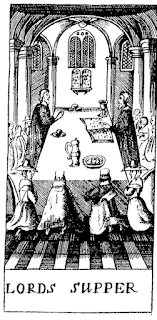
The Teaching of the Anglican Divines in the Time of King James I and King Charles I on the Doctrine of the Holy Eucharist (1858) by Henry Charles Groves - a clergyman of the Church of Ireland - is a fascinating read. Groves was born in 1822 in County Down, received orders in 1849, and died in 1903. What makes this work of his particularly fascinating is how it anticipated, from an Anglican context, Nevin's 1867 The Mystical Presence: A Vindication of the Reformed or Calvinistic Doctrine of the Holy Eucharist .  Groves was responding to and rejecting Tractarian works which, as he demonstrated, misquoted Caroline Divines in order to present them as rejecting a Calvinist understanding of the Sacrament. By contrast, he points to how Laudians and Reformed Conformists (to use our contemporary term) shared a high Reformed eucharistic theology. To put it another way, he is saying that both illustrations accompanying this post shared the same doctrine of the Holy Eucharist. In this extract...

For Grotius, Calvin, and Cassander: 18th century Anglicanism's eirenic reading of the Prayer Book

Image
Today we resume extracts from John Shepherd's A Critical and Practical Elucidation of the Morning and Evening Prayer of the Church of England (1796). At the outset of his discussion of the Venite, Shepherd describes it as "originally composed for the public service". A short footnote addressing this point is worth considering: Grotius thinks it was composed for the Feast of Tabernacles, and Calvin for the Sabbath Day.  A short footnote, yes, but one that captures a significant aspect of how much Anglican opinion regarded the Book of Common Prayer during the 'long 18th century'. Shepherd is very content to describe Luther and Calvin as "two of the most illustrious instruments of the Reformation". As seen previously, he invoked Calvin to explain the purpose of the Absolution at Morning and Evening Prayer. He was, however, hostile to those readings of the Prayer Book which were "too favourable to Calvinistic opinions".  Which brings us to the re...

"Signal promise": the Absolution at Morning and Evening Prayer

Image
As Lent approaches, most of the posts this week will consider the normative way Anglicans over centuries received absolution: that is, by means of "The Absolution or Remission of sins ... pronounced by the Priest" at Mattins and Evensong. To guide our reflections on this Absolution, we turn to  A Critical and Practical Elucidation of the Morning and Evening Prayer of the Church of England (1796), by clergyman John Shepherd. Mindful that the Absolution at Morning and Evening Prayer, "pronounced by the Priest alone", had been a source of Puritan and then Dissenting criticism since the Elizabethan era, Shepherd invokes Calvin in defence of the Absolution as a "signal promise" of forgiveness after confession: The propriety of introducing the Absolution in. this part of our daily service, is acknowledged without reserve by Calvin, whose immense learning, and extraordinary abilities, no one will dispute. This distinguished instrument of the reformation, who was...

"This high mystical and spiritual doctrine": Jelf's Bampton lectures and the richness of Reformed Catholic Eucharistic teaching

Image
In this final extract from the sixth of his 1844 Bampton Lectures,  An inquiry into the means of grace, their mutual connection, and combined use, with especial reference to the Church of England , Jelf - one of those whom Nockles lists as the 'Zs', the post-1833 continuation of the Old High tradition - summarises what he describes as "this high mystical and spiritual doctrine" of the Sacrament. That phrase alone should make us again think of Nevin's account of the High Reformed doctrine of the Supper, The Mystical Presence (1846). Or, as Jelf puts it here, in more than an echo of Calvin, "uniting us mystically, but truly, with the glorified nature of our blessed Lord": This grace we hold to be not a mere suggestion of goodness, nor mere instruction, nor an implanting of motives, nor a sense of mere gratitude in the remembrance of Christ's death; but the real reception of the Body and Blood of Christ, whatever that may mean, "after an heavenly...