Posts

Showing posts with the label John Lonsdale

"That simple grace": Lonsdale and the Old High tradition in the later 19th century

Image
To end our readings from The Life of John Lonsdale (1868) - Bishop of Lichfield 1843-67 and exemplar of the Old High tradition - two extracts from sermons preached by Lonsdale in the last years of his life. Both extracts point to the Old High tradition continuing to present in English parish, over three decades after the beginning of the Oxford Movement.  The first sermon was delivered at the restoration of a parish church in 1863. It is implied in the sermon that the restoration followed Victorian norms, moving away from some 18th century features.  Despite this, Lonsdale emphasised a continuation of simplicity: And still the work is of a simple kind: it is still ... characterized by that simple grace which best becomes the sacred edifices of the Church of England; simple, solemnly simple, as that Church is in its ritual, and forms of worship. Here was the authentic voice of the Old High tradition, rejoicing in - rather than mocking and rejecting - the modest, quiet liturgic...
Neither required nor encouraged: Lonsdale on private confession and absolution

Image
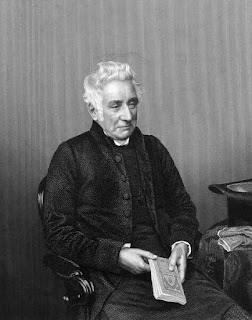
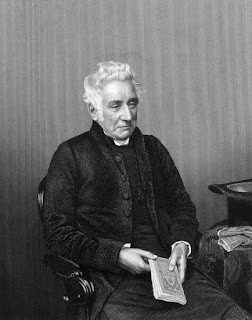
In the last year of his life, 1867, John Lonsdale, Bishop of Lichfield, had to address one of the most theologically and culturally divisive aspects of Anglo-catholic practice in Victorian England: auricular confession. The promotion of auricular confession, as Nockles notes, was one of the most profound differences between the Old High tradition and the Tractarians: "Forgiveness was effectively made conditional upon the sacramental absolution administered by a priest in private confession in a way which the old High Churchmen deplored". As recorded in The Life of John Lonsdale (1868), the Bishop was required to address the matter because of the controversy surrounding a boys' school in his diocese allowing pupils "by the permission of their parents only, to come to confession, and to receive absolution, if they are unable (as the Prayerbook says) by the usual means to satisfy their own conscience, and require further comfort or advice". Lonsdale carefully defe...

"A liberty is here allowed": Lonsdale on the Prayer Book and Baptismal regeneration

Image
Six years before the 1850 Gorham Judgement, the Old High Bishop of Lichfield, John Lonsdale entered into correspondence with one of this clergy who had expressed the view that his conscience was increasingly troubled by the Prayer Book's teaching on Baptismal regeneration. The correspondence was published after the bishop's death in The Life of John Lonsdale (1868). The minister in question had referred to William Wall's 1705 A History of Infant Baptism , to which Lonsdale also pointed in his response: for there appears to me no reason why, as a Minister of the Church of England, you should feel yourself at all called upon to go beyond the view of Baptismal Regeneration which is stated by Wall in the passage quoted by you. How this can be deemed 'a rationalistic view,' I am at a loss to conceive. Neither can I see how any man can take upon himself to say what the formularies of the Church imply. We can only judge of what is expressed. Of course, as you say, differe...

"I wish we were well rid": Lonsdale on the damnatory clauses of the Athanasian Creed

Image
Last week, laudable Practice considered what the The Life of John Lonsdale (1868) - an associate of the Hackney Phalanx and later Bishop of Lichfield (1843-67) - revealed about an Old High view of ceremonial disputes in Victorian Anglicanism. This week we turn to his stance on another matter of debate, the damnatory clauses of the Athanasian Creed.  This was, of course, a long-standing debate. Jeremy Taylor had famously expressed his view that the damnatory clauses lacked "moderate sentence and gentleness of charity". The 1689 Liturgy of Comprehension proposed a rubric stating that these clauses only applied to this "who obstinately deny the substance of the Christian Faith". Despite robust High Church for this Creed in the 18th century, in the face of anti-Trinitarian theologies, it was removed from PECUSA's BCP 1789. This, however, did not prevent the Church of England recognising PECUSA. Unease with the damnatory clauses was evident within the Victorian O...

"A High Churchman of the old school": Lonsdale and Old High/New Low

Image
Prior to Lent, laudable Practice shared extracts from two sermons by John Lonsdale, an associate of the Hackney Phalanx and later Bishop of Lichfield (1843-67). The Life of John Lonsdale (1868), by his son-in-law, provides an interesting insight into Lonsdale as a representative of the Old High tradition. The work describes Lonsdale as "a High Churchman of the old school, broadened by experience, and inclining always to moderation and comprehension". In this, he was not dissimilar from other bishops in the Old High tradition as, for example, Christopher Bethell (Bishop of Gloucester then Exeter,1824-30) and William Jacobson (Bishop of Chester, 1864-84). On ritual matters, it is stated that this "High Churchman of the old school" did not at all identify with ceremonies the Tractarians imported into parish churches from cathedrals, such as bowing to the Holy Table or facing east for the Creed: Neither did he, either in the reading desk, or at the Table, or in his ...

"A vital doctrine of our religion": A Hackney Phalanx sermon on the last things

Image
For today's post, another extract from an 1818 sermon by John Lonsdale, associated with the Hackney Phalanx, on the occasion of the death of Queen Caroline. Lonsdale here challenges stereotypes of the late Georgian Church promoted both by Tractarians and evangelicals, with their accounts of a Church and a dominant theology exclusively defined by natural theology and moralising sermons. In stark contrast to such narratives, Lonsdale - in the midst of a sermon for a time of civic and national mourning - appeals to "the far surer guide" of revelation in order to give a vibrant exposition of the final judgement and the life everlasting: Nor will Reason ever permit us to entertain such unworthy notions of God's attributes, (for I will not suppose the case of direct Atheism) as to believe that he may have impressed our nature with these feelings and faculties merely to deceive us; to buoy us up into a vain imagination that we have another state to look to, after the curtai...

"That great moral chain": A Hackney Phalanx sermon upon the death of a Queen

Image
Today's post is an extract from an 1818 sermon by John Lonsdale, associated with the Hackney Phalanx, on the occasion of the death of Queen Caroline. The sermon demonstrates how the Hackney Phalanx continued a significant and attractive part of Old High teaching, a wise and reasoned account of Christian duties and obligations in the commonwealth. The "great moral chain" which bound together governor and governed underpinned the peace and concord of the commonwealth. It is worth noting that the reference to "princes" as "God's viceregents upon earth" is not a particular claim for monarchical government - a claim renounced by Old High teaching (e.g. see Horsley's 1793 30th January sermon ) - but, rather, an understanding of the vocation of the civil magistrate in light of Romans 13.  When the princes of the people, they, whom the God of order, and the Author of all power, has set over us, fall like other men; when they too, have the grave for th...

"And under such superintendence": A Hackney Phalanx sermon at an 1824 episcopal consecration

Image
Returning to John Lonsdale's sermon at the 1824 consecration of Blomfield for Chester , we see again an example of how the Hackney Phalanx, bearers of the Old High tradition, viewed the episcopal office.  As with Lonsdale's sermon at an 1827 episcopal consecration, the  complete absence of sacerdotal language is striking.   And, again as with the 1827 sermon , there is the use of the language of "superintendence" to describe the episcopate. This is suggestive of the Hookerian moderation of the Old High understanding of the episcopate, reflecting how the Old High tradition sought to encourage episcopacy amongst non-episcopal continental Protestant churches.  Also interesting at the outset of the extract is the implication of a cautious, modest account as to how episcopacy was understood to exercise oversight in succession to the Apostles. Well may the Church rejoice, and honestly may she glory, (since ordinary now occupy the place of extraordinary aids) when she ...

"Neglect, or hatred, from the most learned and accomplished": The Hackney Phalanx against Gibbon

Image
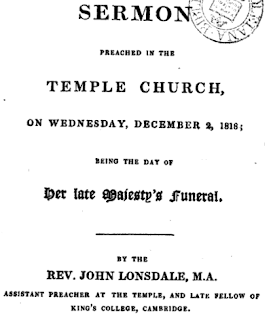
Continuing the series of sermons from those associated with the Hackney Phalanx, an extract from another episcopal consecration sermon - this time the 1824 consecration of Blomfield for Chester - John Lonsdale (ordained 1815, Principal of King's College, London 1839, consecrated Bishop of Lichfield in 1843, died 1867). As can be seen from the title page of this sermon, Lonsdale was chaplain to Charles Manners-Sutton, Archbishop of Canterbury and a strong supporter of the Hackney Phalanx. This extract struck me as quite significant because of assumptions routinely made regarding the Phalanx and the Old High tradition. Lonsdale - in a manner that reminds me of Tom Holland's Dominion - points to the significance of the rejection of Christianity by the Roman elite. Contra Gibbon (referenced in a footnote in the sermon), Lonsdale hails this rejection as evidence of the divine origins of Christianity.  It is also revealing in terms of how the Hackney Phalanx viewed the Churc...

"Our divine commission": a Hackney Phalanx sermon at an episcopal consecration

Image
Should the Government and Country so far forget their GOD as to cast off the Church, to deprive it of its temporal honours and substance, on what will you rest the claim of respect and attention which you make upon your flocks? Hitherto you have been upheld by your birth, your education, your wealth, your connexions; should these secular advantages cease, on what must CHRIST'S Ministers depend?  The question was asked by Newman in Tract One . It carries the implication, of course, that the pre-1833 Church of England and Ireland was dependent upon its established status and that without this status it had little or no theological rationale for its ministry. Tract One is a quite brilliant piece of ecclesiastical propaganda, significantly contributing to the perverse image of Georgian Anglicanism which the Tractarians - with assistance from low church evangelicals - would enthusiastically promote. However, as laudable Practice has previously suggested, such an account of pre-1833 Ang...

"A salutary superintendance": a Hackney Phalanx sermon at an episcopal consecration

Image
Throughout 2022 laudable Practice shared extracts from the sermons of Joseph Holden Pott , associated with the Hackney Phalanx. This year, we will turn to sermons from a variety of associates of the Hackney Phalanx, exploring the thinking of this vibrant and influential expression of the Old High tradition. We begin with sermons by John Lonsdale, who received orders in 1815, becoming Principal of King's College, London in 1839, and consecrated Bishop of Lichfield in 1843, remaining in the see until his death in 1867. That year, of course, was the midway point between the publication of Tract XC and Newman's conversion to Rome.  The first of Lonsdale's sermons for consideration is that preached at the 1827 episcopal consecration of Hugh Percy , Bishop of Rochester (translated the same year to Carlisle, in which see he died in 1856). Perhaps what is most striking about the sermon is the modesty of its claims for the episcopal office.  It is thoroughly Hookerian, without a...