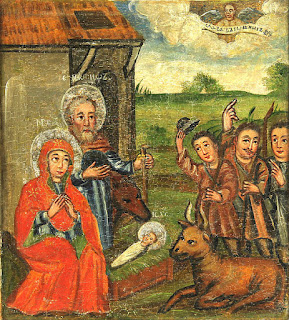
Manger, Glory, Incarnation: a homily at the Dawn Eucharist of Christmas Day

Manger, Glory, Incarnation: the Grand Miracle

At the Dawn Eucharist of Christmas Day, 2021

Luke 2:8-20 

In the quietness of this Christmas morning, our Gospel reading, from Saint Luke’s account of the Nativity of Our Lord, presents us with stark contrasts.

On the one hand there is glory, splendour, majesty.  Angels, the glory of the Lord shining, the heavenly host singing ‘Glory to God in the highest heaven’.  

We hear too of the royal titles of the Christ Child, born in the city of David, Israel’s greatest king; described as ‘anointed’ - for that is what ‘Messiah’ means - like the mighty kings of old; hailed as ‘Saviour’, a title claimed by the Roman emperors, reflecting their authority and the order they upheld.

On the other hand, however, there is poverty, vulnerability, humility.  The news of the birth of the Christ Child is announced to shepherds: hard-working labourers, earthy, carrying the distinct odour of their labour, far removed from the comforts and privileges of the religious and social elites of the day.  

Then there are the circumstances of the birth of the Christ Child, as described by the angel: “you will find a child wrapped in bands of cloth and lying in a manger”.  As Jesus himself would say later, “those who wear soft robes are in royal palaces”: this, a manger used to feed animals, is no palace, here there are no soft robes.

These contrasts - glory, splendour, majesty and poverty, vulnerability, humility - come together in the Nativity of Our Lord.  They do not cancel each other out, they do not contradict each other, they do not erase each other.  They are brought together, held together in the Christ Child, in the person of Our Lord Jesus Christ.

In the poverty, vulnerability, humility of human nature we, with the Blessed Virgin Mary, with Saint Joseph, with the shepherds, behold the glory, splendour, majesty of God. Here we behold the mystery of Christmas: in the Christ Child we see humanity and divinity united, without confusion, without change, without division, without separation.

True humanity, true divinity, united in the Christ Child. As one ancient Christian confession of faith declares: “we believe and confess: that our Lord Jesus Christ, the Son of God, is God and Man; God, of the Substance of the Father, begotten before the worlds: and Man, of the Substance of his Mother, born in the world”.

In the quietness and stillness of Christmas morning, we encounter what C.S. Lewis described as ‘the grand miracle’ at the very heart of the Christian Faith: the glory, splendour, and majesty of the Eternal becomes present in poverty, vulnerability, and humility - in a Manger, on the Cross, in the Tomb.

Gazing with the shepherds this morning on the Christ Child in the Manger we behold the grace, mercy, and love of God, assuming the poverty, vulnerability, and humility of our humanity that we might share in the glory, splendour, and majesty of the very life of God.  

With the shepherds, then, let us at this Eucharist, throughout this Christmas season, and in our daily lives ‘glorify and praise God for all we have seen and heard’ in the grand miracle of the birth of Our Lord Jesus Christ. Amen.

(The illustration is a 17th century Ukrainian painting, from an iconostasis.)

Comments

Popular posts from this blog

Why I support the ordination of women: a High Church reflection

A number of commenters on this blog have asked about my occasional expressions of support for the ordination of women to all three orders.  With some hesitation, I have decided to post a summary of my own views on this matter.  The hesitation is because I have sought on this blog to focus on issues and themes which can unify those who identify with or have respect (grudging or otherwise!) for what we might term 'classical' Anglicanism (the Anglicanism of the Formularies and - yes - of the Old High Church tradition).  Some oppose the ordination of women (and I have friends and colleagues who do so, Anglo-Catholic, High Church, and Reformed Evangelical).  Some of us support it (again, friends and colleagues covering a wide range of theological traditions). Below, I have organised my thinking around 5 points (needless to say, no reference to Dort is implied). 1. The Declaration for Subscription required of clergy in the Church of Ireland states: (6) I promise to submit ...

How the Old High tradition continued

Charles Gore's 1914 letter to the clergy of his diocese, ' The Basis of Anglican Fellowship ', can be regarded as a classical expression of the Prayer Book Catholic tradition.  A key part of the letter - entitled 'Romanizing in the Church of England' - addressed the "Catholic movement", questioning beliefs and practices within it which tended to "a position which makes it very difficult for its extremer representatives to give an intelligible reason why they are not Roman Catholics".  Gore provides the outlines of an alternative account and experience of catholicity within Anglicanism, defined by three characteristics.  What is particularly interesting about these characteristics is their continuity with the older High Church tradition.  Indeed, the central characteristic as set out by Gore was integral to High Church claims over centuries: To accept the Anglican position as valid, in any sense, is to appeal behind the Pope and the authority of t...

Pride, progressive sectarianism, and TEC on Facebook

Let me begin this post with an assumption that will be rejected by some readers of laudable Practice , but affirmed by other readers. Observing Pride is an understandable aspect of the public ministry of TEC.  On previous occasions , I have rather robustly called for TEC to be much more aware and respectful of the social conservatism of the Red states and regions in which it ministers. A failure to do so risks TEC declining yet further into the irrelevance of progressive sectarianism.  At the same time, TEC also obviously ministers in deep Blue states and metropolitan areas - and is the only Mainline Protestant tradition in which a majority of its members vote Democrat .* With Pride now an established civic commemoration, particularly in such contexts, there is a case for TEC affirming those aspects of Pride - the dignity of gay men and lesbian women, their contribution to civic life, and their place in the church's life - which cohere with a Christian moral vision. (I will n...