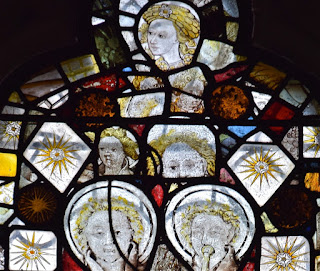
"Heaven and earth are a kin": Restoration and Revolution era All Saints' Day sermons

As Hallowtide approaches, extracts from three Restoration and Revolution era sermons (respectively, 1661, a 1669 funeral sermon, and 1699) for All Saints' Day, indicating how the feast continued to be observed by Anglicans in the decades after 1660 and how a lively understanding of the Communion of Saints persisted:

This is a time of uniting; this day's Solemnity calls for it: the Church now commemorating that grand Union betwixt Heaven and Earth, in the Unity and Community of All-Saints ...

Angels themselves, though we know not of what Original Extraction, before, or above us; yet, as the same Author elsewhere saith, acknowledge ... there is Consanguinity betwixt them and us. And Origen affirms, Heaven and Earth are a Kin (as it were) and the Kindred this day commemorated ...

Which several Openings in Heaven (as aforesaid) to receive and take in Earth: and holy combinations on Earth, Earth (as it were) mixing with Heaven, me thinks should much encourage us to the ready embracement of those uniting Motions, which this Text affords us, especially at such a time as this; concerning which (beside what hath been already spoken in that regard) I shall only add that of the Psalmist (which hints both the day, and its duty,) Sing unto the Lord all ye Saints of his, and give thanks, &c. All Saints, except some new ones, who (they say) care not much for any Singing, and so how they may share in the Day I know not, but doubt they will not join in the Duty.

---

The Communion of Saints is a Tenet of our Faith. Now as we ought not to Pray To them or For them, so we may and must Praise them. This is the least we can do in Return for those great Offices they did the Church Militant, while they were with Us, and now do, they are with God ...

Whither She is gone Bless Soul, to increase the number of Saints, whom the Church this day Commemorates ... And may the Echo of her Praises tend to the setting forth of the Praise of God, the Father of Spirits, and the Father of Lights, from whom cometh every good and perfect Gift. To whom, the Immortal and Ever-blessed, Three Persons and One God, We, together with the whole Company of All his Saints, ascribe, as is most due, all Honour, Praise and Glory, Now and for Ever. Amen.

---

It signifieth that Communication of himself face to face in Glory, whereby God for ever maketh Blessed the Holy Angels and Saints in Heaven; which is call'd by Divines, the Beatifical Vision; and by St. Jude, the Presence of Glory ... This the Blessed Saints and Martyrs, whom we this Day commemorate, have long since experienced ...

Let us therefore walk Uprightly both with God and Man, that we may in some measure feel the Presence of God here in Divine Comforts and Consolations, as Tastes and Assurances of the Full Joys of Heaven that await us. When our Blessed Lord shall come with this Euge [i.e. expression of approval], Well done thou true and faithful servant, receive the Kingdom prepared for you. That this may be the happy Condition of all here; Let us humbly beseech God to give us Grace so to follow thy Blessed Saints in all Virtuous and Godly Living, that we may come to those Unspeakable Joys which thou hast prepared for them that love Thee, through Jesus Christ our Lord: To whom with the Father and Holy Ghost, be ascribed all Power, Praise, and Thanksgiving, now and for evermore. Amen.

Comments

Popular posts from this blog

Why I support the ordination of women: a High Church reflection

A number of commenters on this blog have asked about my occasional expressions of support for the ordination of women to all three orders.  With some hesitation, I have decided to post a summary of my own views on this matter.  The hesitation is because I have sought on this blog to focus on issues and themes which can unify those who identify with or have respect (grudging or otherwise!) for what we might term 'classical' Anglicanism (the Anglicanism of the Formularies and - yes - of the Old High Church tradition).  Some oppose the ordination of women (and I have friends and colleagues who do so, Anglo-Catholic, High Church, and Reformed Evangelical).  Some of us support it (again, friends and colleagues covering a wide range of theological traditions). Below, I have organised my thinking around 5 points (needless to say, no reference to Dort is implied). 1. The Declaration for Subscription required of clergy in the Church of Ireland states: (6) I promise to submit ...

How the Old High tradition continued

Charles Gore's 1914 letter to the clergy of his diocese, ' The Basis of Anglican Fellowship ', can be regarded as a classical expression of the Prayer Book Catholic tradition.  A key part of the letter - entitled 'Romanizing in the Church of England' - addressed the "Catholic movement", questioning beliefs and practices within it which tended to "a position which makes it very difficult for its extremer representatives to give an intelligible reason why they are not Roman Catholics".  Gore provides the outlines of an alternative account and experience of catholicity within Anglicanism, defined by three characteristics.  What is particularly interesting about these characteristics is their continuity with the older High Church tradition.  Indeed, the central characteristic as set out by Gore was integral to High Church claims over centuries: To accept the Anglican position as valid, in any sense, is to appeal behind the Pope and the authority of t...

Pride, progressive sectarianism, and TEC on Facebook

Let me begin this post with an assumption that will be rejected by some readers of laudable Practice , but affirmed by other readers. Observing Pride is an understandable aspect of the public ministry of TEC.  On previous occasions , I have rather robustly called for TEC to be much more aware and respectful of the social conservatism of the Red states and regions in which it ministers. A failure to do so risks TEC declining yet further into the irrelevance of progressive sectarianism.  At the same time, TEC also obviously ministers in deep Blue states and metropolitan areas - and is the only Mainline Protestant tradition in which a majority of its members vote Democrat .* With Pride now an established civic commemoration, particularly in such contexts, there is a case for TEC affirming those aspects of Pride - the dignity of gay men and lesbian women, their contribution to civic life, and their place in the church's life - which cohere with a Christian moral vision. (I will n...