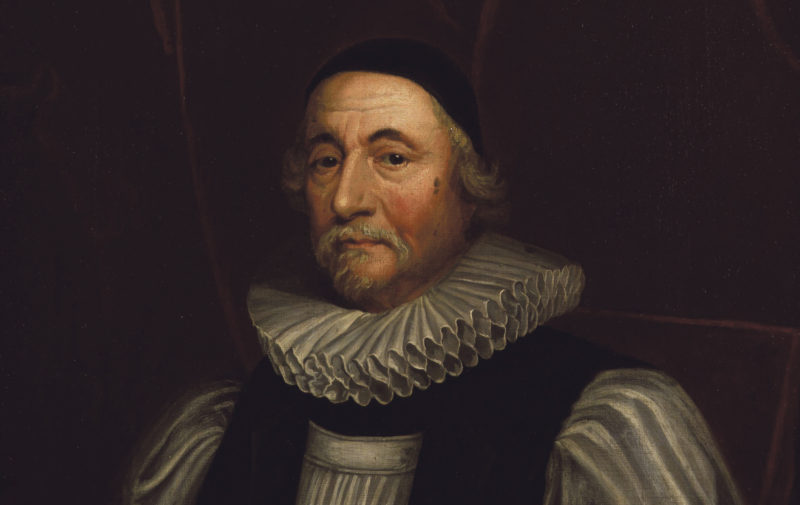
'There is that sacramental union': Ussher the Reformed Conformist and the Sacrament of Baptism

Ussher may seem to be an odd source for a blog which stands in the Old High tradition. As laudable Practice has sought to previously demonstrate, however, there is good precedent for an Old High regard for Ussher. The Laudian Bramhall, after all, praised his predecessor in the See of Armagh as "an ornament to the Reformed Church". This year's Jeremy Taylor Week on the blog also explored how Taylor the Laudian and Ussher the Reformed Conformist shared theological commitments on the liturgy, episcopacy, the Royal Supremacy, the Lord's Supper, and the Reformed identity of the Church of England.

There is a rich seam of sacramental teaching in Ussher's works, underpinning the view that the theological gap between Reformed Conformists and Laudians is too often overstated and exaggerated. This is no new claim. Henry Charles Groves, in his 1858 work refuting Tractarian interpretations, declared that Reformed Conformists such as Ussher had a eucharistic theology "as high as that of any of Laud's school, and higher than that of some of them". This, for example, is reflected in Ussher's theology of sacramental consecration, indistinguishable from the account of sacramental consecration given by many Laudians.

We also see this given expression in Ussher's theology of Baptism. In A Body of Divinity (1645), Ussher affirms that the water of the Sacrament is consecrated by the Word of institution and by prayer:

as every thing is sanctified by the Word of God and prayer, so in especiall manner the Sacramentall water in baptisme is blessed and consecrated by the Word of institution, and prayer to God for a blessing upon his own Ordinance.

This is what we see in the prayer at the font, before Baptism is administered, in the 1559 rite:

Almighty everliving God, whose most derely beloved son Jesus Christe, for the forgevenes of our sinnes, did shed out his moste precious syde bothe water and bloude, and gave commaundement to his disciples that they should go teache al nacions, and baptise them in the name of the father, the sonne, and of the holy Ghost : Regard, we beseche the, the supplicacions of thy congregacion, and graunt that al thy servantes whiche shalbe baptised in this water, may receve the fulnes of thy grace, and ever remaine in the nombre of thy faithful and elect chyldren, through Jesus Christ our Lord. Amen.

As to the sacramental meaning of Baptism, Ussher emphasises the "sacramental union" between sign and thing signified:

But is Christ and the cleansing power of his bloud only barely signified in the Sacrament of Baptisme?

Nay more; the inward things are really exhibited to the beleever as well as the outward; there is that sacramentall union between them that the one is conveyed and sealed up by the other: hence are those phrases of being born again of water and of the holy Ghost Joh. 3. 5. of cleansing by the washing of water, Eph. 5. 26. so arise and be baptized, and wash away thy sins, Acts 22. 16. so Rom. 6. 3. we are buried with Christ by baptisme, &c. the Sacraments being rightly received, doe effect that which they doe represent.

Note how Ussher explicitly understands these key New Testament passages - particularly John 3:5 and Romans 6:3 - to refer to the Sacrament. This also provides a significant means for interpreting the post-baptismal declaration in the 1559 rite:

Seying now, derely beloved brethren that these children be regenerate and graffed into the bodye of Christes congregacion ...

The water is consecrated; there is a sacramental union between element and grace, sign and thing signified; the Sacrament - "being rightly received" - does "effect" that which it represents. 

What Ussher means by "being rightly received" will be considered in a later post. For the moment, we can state that the phrase itself is no stumbling block for Laudians: it is found in the Articles of Religion, it is stated by Hooker, and would be understood by Laudians (following Hooker) to refer to the Sacrament being administered in the Church's faith confessed by the godparents in the Apostles' Creed. In other words, if the wise counsel of Charles I's Declaration, prefixed to the Articles of Religion, is heeded - "that all further curious search be laid aside, and these disputes shut up in God's promises, as they be generally set forth to us in the holy Scriptures, and the general meaning of the Articles of the Church of England according to them" - the Laudian heart and mind can heartily agree with Ussher's account of the Sacrament of Baptism.

What is more, mindful of the often lamentably impoverished theology of Baptism encountered amongst many contemporary evangelical Anglicans, who do indeed hold to an understanding that the Sacrament 'only barely signifies' God's grace in Christ, those of us who are Laudian and Old High would surely want to encourage Ussher's rich theology of "sacramental union" as a means of renewing an Anglican theology of Holy Baptism.

Comments

Popular posts from this blog

Why I support the ordination of women: a High Church reflection

A number of commenters on this blog have asked about my occasional expressions of support for the ordination of women to all three orders.  With some hesitation, I have decided to post a summary of my own views on this matter.  The hesitation is because I have sought on this blog to focus on issues and themes which can unify those who identify with or have respect (grudging or otherwise!) for what we might term 'classical' Anglicanism (the Anglicanism of the Formularies and - yes - of the Old High Church tradition).  Some oppose the ordination of women (and I have friends and colleagues who do so, Anglo-Catholic, High Church, and Reformed Evangelical).  Some of us support it (again, friends and colleagues covering a wide range of theological traditions). Below, I have organised my thinking around 5 points (needless to say, no reference to Dort is implied). 1. The Declaration for Subscription required of clergy in the Church of Ireland states: (6) I promise to submit ...

How the Old High tradition continued

Charles Gore's 1914 letter to the clergy of his diocese, ' The Basis of Anglican Fellowship ', can be regarded as a classical expression of the Prayer Book Catholic tradition.  A key part of the letter - entitled 'Romanizing in the Church of England' - addressed the "Catholic movement", questioning beliefs and practices within it which tended to "a position which makes it very difficult for its extremer representatives to give an intelligible reason why they are not Roman Catholics".  Gore provides the outlines of an alternative account and experience of catholicity within Anglicanism, defined by three characteristics.  What is particularly interesting about these characteristics is their continuity with the older High Church tradition.  Indeed, the central characteristic as set out by Gore was integral to High Church claims over centuries: To accept the Anglican position as valid, in any sense, is to appeal behind the Pope and the authority of t...

1928 practices and the 1979 book: unthinking conservatism or popular piety?

Those responsible for Earth & Altar - a new blog emanating from a group within TEC - are to be congratulated for an excellent contribution to wider Anglican discussion and debate. The commitment to "an expansively conceived credal orthodoxy as fully compatible with LGBTQ inclusion, gender equality, and racial justice" is an important part of a wider retrieval of creedal orthodoxy within what we might call the post-liberal generation. It is in this spirit that I want to respond to a recent post on the site by Andrew McGowan , Dean of the Berkeley Divinity School at Yale and Professor of Anglican Studies at Yale Divinity School.  Against the background of another round of "ill-defined" liturgical revision in TEC, he understandably urges that a fuller reception of the 1979 BCP should occur before further reforms. In doing so, however, he takes aim at what he describes as "clinging to the ritual structures of 1928" while using the text of 1979.  We ...