"Dispose the heart to seek treasure": A Hackney Phalanx sermon for Quinquagesima

From A Course of Sermons, for the Lord's Day throughout the Year, Volume I (1817) by Joseph Holden Pott - associated with the Hackney Phalanx - a sermon for Quinquagesima Sunday.  As with the sermons for Septuagesima and Sexagesima, Pott quite clearly is echoing the ancient themes of preparation for Lent, a season for the renewal and recovery of the covenant of grace:

Let us remember too, that the covenant of salvation, of which we are called to be partakers, has its peculiar and appointed signs. It is accompanied by solemn sacraments, which form the special tokens of God's favour, and the pledges of those mercies which should hold the first place in our thoughts and desires. It is from covenanted promises, and from covenanted succours and supplies, that we must derive our confidence in all our course. These should be the chief topics of our careful study, through all periods of our transitory life: and then short and uncertain as that life is, it will become the happy earnest of eternal blessings.

Let it not be counted a small thing that God should vouchsafe to bind himself to vows and covenants. It is our best source of comfort and assurance that he doth so. Not because an oath is requisite to confirm the truth of God, but because the covenant, and the oath, furnish that ground of trust to us, which the sole knowledge of God, and ourselves, of his infinite perfections and our frailty and demerits, could not have afforded. Let him who makes light of the covenant of grace and mercy, for salvation, come forward with his own plea, and see to what his claims and his pretensions will amount. Will he say with the Pharisee, "Lord, I thank thee that I am not as other men are", and will he then proceed to challenge his reward? Let him remember that the Pharisee departed self-satisfied indeed, but not accepted of the Lord. Will he plead with the boastful young man in the Gospel? "All these things have I kept from my youth up." Let him be prepared to hear, that there is some thing wherein he is deficient; something which, when it is required, will prove too hard a trial for his strength. Will he put in his claim only for the general mercies of the Lord, and rest there for the pardon of his sins?

... Let us learn to cultivate and cherish in our hearts, a just sense of those blessings of which the patriarchs of old time had but distant views, but which are openly displayed and offered for our acceptance. Let us store them in our breasts, and make known our belief in them, and our care of them, by our lives and conduct; for if we do not so dispose the heart to seek its treasure in them, and so frame the life to seek them, we shall lose our part in the proffered benefit, and the word of promise will not stand in our behalf.

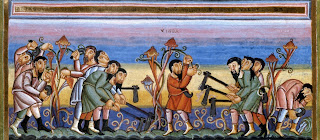
(The illustration is from the 11th century Codex Aureus of Echternach, an illuminated Gospel book, showing the parable of the vineyard owners and labourers.  The parable is the Gospel reading for Septuagesima, preparing us to "Go ye also into the vineyard": that is, to enter into the discipline of Lent.)

Comments

Popular posts from this blog

Why I support the ordination of women: a High Church reflection

A number of commenters on this blog have asked about my occasional expressions of support for the ordination of women to all three orders.  With some hesitation, I have decided to post a summary of my own views on this matter.  The hesitation is because I have sought on this blog to focus on issues and themes which can unify those who identify with or have respect (grudging or otherwise!) for what we might term 'classical' Anglicanism (the Anglicanism of the Formularies and - yes - of the Old High Church tradition).  Some oppose the ordination of women (and I have friends and colleagues who do so, Anglo-Catholic, High Church, and Reformed Evangelical).  Some of us support it (again, friends and colleagues covering a wide range of theological traditions). Below, I have organised my thinking around 5 points (needless to say, no reference to Dort is implied). 1. The Declaration for Subscription required of clergy in the Church of Ireland states: (6) I promise to submit ...

How the Old High tradition continued

Charles Gore's 1914 letter to the clergy of his diocese, ' The Basis of Anglican Fellowship ', can be regarded as a classical expression of the Prayer Book Catholic tradition.  A key part of the letter - entitled 'Romanizing in the Church of England' - addressed the "Catholic movement", questioning beliefs and practices within it which tended to "a position which makes it very difficult for its extremer representatives to give an intelligible reason why they are not Roman Catholics".  Gore provides the outlines of an alternative account and experience of catholicity within Anglicanism, defined by three characteristics.  What is particularly interesting about these characteristics is their continuity with the older High Church tradition.  Indeed, the central characteristic as set out by Gore was integral to High Church claims over centuries: To accept the Anglican position as valid, in any sense, is to appeal behind the Pope and the authority of t...

1928 practices and the 1979 book: unthinking conservatism or popular piety?

Those responsible for Earth & Altar - a new blog emanating from a group within TEC - are to be congratulated for an excellent contribution to wider Anglican discussion and debate. The commitment to "an expansively conceived credal orthodoxy as fully compatible with LGBTQ inclusion, gender equality, and racial justice" is an important part of a wider retrieval of creedal orthodoxy within what we might call the post-liberal generation. It is in this spirit that I want to respond to a recent post on the site by Andrew McGowan , Dean of the Berkeley Divinity School at Yale and Professor of Anglican Studies at Yale Divinity School.  Against the background of another round of "ill-defined" liturgical revision in TEC, he understandably urges that a fuller reception of the 1979 BCP should occur before further reforms. In doing so, however, he takes aim at what he describes as "clinging to the ritual structures of 1928" while using the text of 1979.  We ...