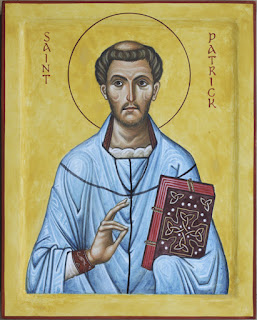
Saint Patrick and the Laudian vision

Responding to the claim of a Roman apologist that "Pope Celestine" sent "St. Patrick into Ireland", thus supposedly demonstrating that "the Bishops of Rome exercised ecclesiastical jurisdiction over the Britannic Churches", Bramhall points to the consecration and sending of Patrick (by bishops in Gaul) as exemplifying a relationship between neighbouring churches rather than any claim jurisdiction.  As an example, he notes how "a French synod" - not the Bishop of Rome - was responsible for aiding the Church of the Britons against the influence of the Pelagians:

If the Bishop of Rome had been reputed to be Patriarch of Britain, and much more if he had been acknowledged to be a spiritual monarch, it is not credible that the Britannic Church should have applied itself for assistance altogether to their neighbours and not at all to their superior.

When he turns to the mission of Patrick, Bramhall declares that it likewise demonstrates "not one syllable of any jurisdiction" claimed by the Roman See, but rather evangelisation and the building up of a national Church in communion with its neighbours:

I confess, here are store of instances for preaching and baptizing and ordaining and converting; but if every word he saith was true, it is not at all material to the question. Our question is concerning exterior jurisdiction in foro Ecclesie; but the acts mentioned by him are all acts of the key of order, not of the key of jurisdiction. If he do thus mistake one key for another, he will never be able to open the right door. He accustometh himself to call every ordinary messenger a "legate". But let him shew me that they ever exercised legantine authority in Britain. That he doth not, because he cannot. The Britannic and English Churches have not been wanting to send out devout persons to preach to foreign nations, to convert them , to baptize them, to ordain them pastors; yet without challenging any jurisdiction over them ...

If there be nothing in it but baptizing, he [i.e. the Roman apologist] may as well save his labour, unless he think that baptizing is an act of jurisdiction, which his own schools make not to be so much as an act of the key of order. Ireland was the ancient Scotland. The Irish Scots were converted by St. Patrick, the British Scots by St. Columba ...

In all the instances, which he hath brought hitherto, we find nothing but preaching and converting and christening, not one syllable of any jurisdiction. Will the British records afford us so many instances of this kind, and not so much as one of any legislative or judiciary act? Then certainly there were none in those days.

Bramhall, in other words, portrays the mission of Saint Patrick cohering with the Laudian vision of episcopal national churches maintaining communion without claiming jurisdiction - of the 'Britannic Churches', of which Saint Patrick was one of the founders, standing alongside "the Churches of Italy, France, Spain, Germany" (Canon XXX of 1604), with the Roman Church being "a sister to the British Church, but a mistress to no Church".

From The Works of The Most Reverend Father in God, John Bramhall, Volume II.

(The icon of Saint Patrick is by contemporary Orthodox iconographer Aidan Hart.)

Comments

Popular posts from this blog

Why I support the ordination of women: a High Church reflection

A number of commenters on this blog have asked about my occasional expressions of support for the ordination of women to all three orders.  With some hesitation, I have decided to post a summary of my own views on this matter.  The hesitation is because I have sought on this blog to focus on issues and themes which can unify those who identify with or have respect (grudging or otherwise!) for what we might term 'classical' Anglicanism (the Anglicanism of the Formularies and - yes - of the Old High Church tradition).  Some oppose the ordination of women (and I have friends and colleagues who do so, Anglo-Catholic, High Church, and Reformed Evangelical).  Some of us support it (again, friends and colleagues covering a wide range of theological traditions). Below, I have organised my thinking around 5 points (needless to say, no reference to Dort is implied). 1. The Declaration for Subscription required of clergy in the Church of Ireland states: (6) I promise to submit ...

How the Old High tradition continued

Charles Gore's 1914 letter to the clergy of his diocese, ' The Basis of Anglican Fellowship ', can be regarded as a classical expression of the Prayer Book Catholic tradition.  A key part of the letter - entitled 'Romanizing in the Church of England' - addressed the "Catholic movement", questioning beliefs and practices within it which tended to "a position which makes it very difficult for its extremer representatives to give an intelligible reason why they are not Roman Catholics".  Gore provides the outlines of an alternative account and experience of catholicity within Anglicanism, defined by three characteristics.  What is particularly interesting about these characteristics is their continuity with the older High Church tradition.  Indeed, the central characteristic as set out by Gore was integral to High Church claims over centuries: To accept the Anglican position as valid, in any sense, is to appeal behind the Pope and the authority of t...

Pride, progressive sectarianism, and TEC on Facebook

Let me begin this post with an assumption that will be rejected by some readers of laudable Practice , but affirmed by other readers. Observing Pride is an understandable aspect of the public ministry of TEC.  On previous occasions , I have rather robustly called for TEC to be much more aware and respectful of the social conservatism of the Red states and regions in which it ministers. A failure to do so risks TEC declining yet further into the irrelevance of progressive sectarianism.  At the same time, TEC also obviously ministers in deep Blue states and metropolitan areas - and is the only Mainline Protestant tradition in which a majority of its members vote Democrat .* With Pride now an established civic commemoration, particularly in such contexts, there is a case for TEC affirming those aspects of Pride - the dignity of gay men and lesbian women, their contribution to civic life, and their place in the church's life - which cohere with a Christian moral vision. (I will n...