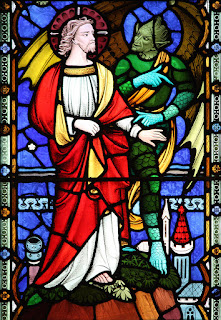
"We must be willing to contend": A Hackney Phalanx sermon for the Third Sunday in Lent

From A Course of Sermons, for the Lord's Day throughout the Year, Volume I (1817) by Joseph Holden Pott - associated with the Hackney Phalanx - a sermon for the Third Sunday in Lent. This extract echoes Lenten preaching and piety across the centuries, on the need for the Christian to contend against the evil one.  The ascetic seriousness of the sermon is indicated at its opening - "Our ruin and our redemption, our subjection to the tyranny of Satan, and our deliverance by the might and succour of a conquering Leader".  It points to something rather different than the 'High and Dry' critique levelled by Tractarianism against the Old High tradition.

Too true it is, that the common enemy is still received among men. He has his trains and subtle ties to carry on his malicious purposes, though his own armour, wherein he defied God, is taken from him, and his own head bruised and crushed by the triumphs of the cross. He has the spirit of delusion still to practise with for a season, though his day be fixed. He has innumerable false maxims to produce on all occasions, in order to mislead those who begin to falter in their way. He has deceitful arguments fitted to all dispositions, and accommodated to the different tempers, and the several designs of men. He has his deep philosophy, and crafty reasonings, dressed in all the pomp of letters, seasoned perhaps with strokes of wit, and backed by ridicule, or perplexed with pretended learning, and perverse refinements ...

The main duty which binds upon us not to remain quiet and inactive witnesses of the great contest, in which our Leader still vouchsafes to be engaged, and which he once sustained, in person, on the same field of conflict and encounter. We are called to fight under his standard. It is not merely for the sake of adapting figurative ornaments to his discourse, that St. Paul describes the arms and weapons which we are to employ in this warfare with the common foe. He reminds us, that we must be willing to contend, if we expect to share the triumph. He says, concerning his own service, "I have fought the good fight": and our Lord had said before, "He that is not with me, is against me". Let it be our part, then, to join a victorious standard, and to bless God for the succours of that mighty Leader, who can cast out the strong man, armed as he is with all his instruments of deceit and death , and can deliver us from his bonds, and redeem us for ever from his tyranny.

Comments

Popular posts from this blog

Why I support the ordination of women: a High Church reflection

A number of commenters on this blog have asked about my occasional expressions of support for the ordination of women to all three orders.  With some hesitation, I have decided to post a summary of my own views on this matter.  The hesitation is because I have sought on this blog to focus on issues and themes which can unify those who identify with or have respect (grudging or otherwise!) for what we might term 'classical' Anglicanism (the Anglicanism of the Formularies and - yes - of the Old High Church tradition).  Some oppose the ordination of women (and I have friends and colleagues who do so, Anglo-Catholic, High Church, and Reformed Evangelical).  Some of us support it (again, friends and colleagues covering a wide range of theological traditions). Below, I have organised my thinking around 5 points (needless to say, no reference to Dort is implied). 1. The Declaration for Subscription required of clergy in the Church of Ireland states: (6) I promise to submit ...

How the Old High tradition continued

Charles Gore's 1914 letter to the clergy of his diocese, ' The Basis of Anglican Fellowship ', can be regarded as a classical expression of the Prayer Book Catholic tradition.  A key part of the letter - entitled 'Romanizing in the Church of England' - addressed the "Catholic movement", questioning beliefs and practices within it which tended to "a position which makes it very difficult for its extremer representatives to give an intelligible reason why they are not Roman Catholics".  Gore provides the outlines of an alternative account and experience of catholicity within Anglicanism, defined by three characteristics.  What is particularly interesting about these characteristics is their continuity with the older High Church tradition.  Indeed, the central characteristic as set out by Gore was integral to High Church claims over centuries: To accept the Anglican position as valid, in any sense, is to appeal behind the Pope and the authority of t...

Pride, progressive sectarianism, and TEC on Facebook

Let me begin this post with an assumption that will be rejected by some readers of laudable Practice , but affirmed by other readers. Observing Pride is an understandable aspect of the public ministry of TEC.  On previous occasions , I have rather robustly called for TEC to be much more aware and respectful of the social conservatism of the Red states and regions in which it ministers. A failure to do so risks TEC declining yet further into the irrelevance of progressive sectarianism.  At the same time, TEC also obviously ministers in deep Blue states and metropolitan areas - and is the only Mainline Protestant tradition in which a majority of its members vote Democrat .* With Pride now an established civic commemoration, particularly in such contexts, there is a case for TEC affirming those aspects of Pride - the dignity of gay men and lesbian women, their contribution to civic life, and their place in the church's life - which cohere with a Christian moral vision. (I will n...