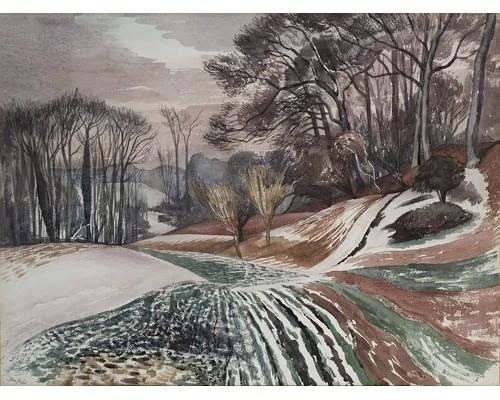
Winter Days, Advent Embertide

We went to the woods for holly
On days that were five below;
The river a glass slide, the skies such pale blue
The world was a kind of white ...

We came back from the glades with hands
All red and raw, words slurred.
Somewhere a muffled snowball sun;
In the trees only crows and quiet - from Kenneth Steven, 'One Winter', in Evensong (2011).

Today is the first of the Advent Ember Days.  As I write this, I am looking out on a cold, gloomy afternoon.  Household lights are needed throughout the day.  Sunset will be at 4pm.  This is Winter.

The prayer, fasting, and abstinence of Advent Embertide ensures that we enter into Winter not grudgingly, not overwhelmed, not distracted.  "The Ember Days at the Four Seasons" (to quote the Prayer Book's 'Days of Fasting, or Abstinence') prepares us to receive each new season as the gift of the One who "appointed the moon for certain seasons" (Ps.104:19).  This is no less so with Winter.  Yes, as Donne so memorably declared, these are days when "life is shrunk, Dead and interr'd".  But, we and the land need this rest after the glories of High Summer and the riches of Autumn.  A retreat into domesticity and a quieter pace prepares us for a new year and the change in routine which Spring will herald. 

Advent Embertide also recalls us to a deepened sense of dependence as we enter into Winter.  Inclement weather, difficult driving conditions, cold and flu season, the financial challenges that can come with additional household heating costs, the increased demands on public services, the challenges faced by the elderly, the poor, the homeless: the Ember Days are rooted in the physical and the practical, and these concerns can and should be gathered up in our prayer and abstinence during Advent Embertide, shaping what love of neighbour means during Winter.

These Advent Ember Days also fall, of course, as festive celebrations occur ahead of Christmas Day.  Advent Embertide requires no Scrooge-like response to these early celebrations (we can leave not enjoying Christmas festivities to latter day Puritans), but these days do have the virtue of reminding us of the Advent call to penitence in the closing days of the liturgical season.  Acts of abstinence during these Ember Days can embody the call of Advent and kindle in us a right spirit as we prepare to celebrate the Lord's Nativity.

Lord, 
we beseche thee, geve eare to our prayers, 
and by thy gracious visitacion 
lighten the darkenes of our hearte, 
by our Lorde Jesus Christe - Collect for the Third Sunday of Advent, BCP 1559.

(The painting is John Northcote Nash, 'Winter Evening, Wormingford', 1967.)

Comments

Popular posts from this blog

Why I support the ordination of women: a High Church reflection

A number of commenters on this blog have asked about my occasional expressions of support for the ordination of women to all three orders.  With some hesitation, I have decided to post a summary of my own views on this matter.  The hesitation is because I have sought on this blog to focus on issues and themes which can unify those who identify with or have respect (grudging or otherwise!) for what we might term 'classical' Anglicanism (the Anglicanism of the Formularies and - yes - of the Old High Church tradition).  Some oppose the ordination of women (and I have friends and colleagues who do so, Anglo-Catholic, High Church, and Reformed Evangelical).  Some of us support it (again, friends and colleagues covering a wide range of theological traditions). Below, I have organised my thinking around 5 points (needless to say, no reference to Dort is implied). 1. The Declaration for Subscription required of clergy in the Church of Ireland states: (6) I promise to submit ...

How the Old High tradition continued

Charles Gore's 1914 letter to the clergy of his diocese, ' The Basis of Anglican Fellowship ', can be regarded as a classical expression of the Prayer Book Catholic tradition.  A key part of the letter - entitled 'Romanizing in the Church of England' - addressed the "Catholic movement", questioning beliefs and practices within it which tended to "a position which makes it very difficult for its extremer representatives to give an intelligible reason why they are not Roman Catholics".  Gore provides the outlines of an alternative account and experience of catholicity within Anglicanism, defined by three characteristics.  What is particularly interesting about these characteristics is their continuity with the older High Church tradition.  Indeed, the central characteristic as set out by Gore was integral to High Church claims over centuries: To accept the Anglican position as valid, in any sense, is to appeal behind the Pope and the authority of t...

Pride, progressive sectarianism, and TEC on Facebook

Let me begin this post with an assumption that will be rejected by some readers of laudable Practice , but affirmed by other readers. Observing Pride is an understandable aspect of the public ministry of TEC.  On previous occasions , I have rather robustly called for TEC to be much more aware and respectful of the social conservatism of the Red states and regions in which it ministers. A failure to do so risks TEC declining yet further into the irrelevance of progressive sectarianism.  At the same time, TEC also obviously ministers in deep Blue states and metropolitan areas - and is the only Mainline Protestant tradition in which a majority of its members vote Democrat .* With Pride now an established civic commemoration, particularly in such contexts, there is a case for TEC affirming those aspects of Pride - the dignity of gay men and lesbian women, their contribution to civic life, and their place in the church's life - which cohere with a Christian moral vision. (I will n...