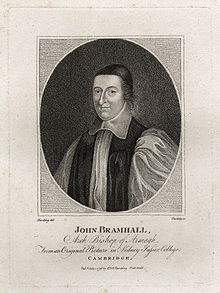
Looking East: Bramhall praising the Orthodox and Oriental Orthodox

An extract from Bramhall, again responding to a work by the Roman titular Bishop of Chalcedon, robustly denying the suggestion that the Eastern Churches are schismatic and thus not part of the Catholic Church. In looking to the Churches of East as an example of episcopal national churches, holding to the Faith of the Councils and belonging to the Church Catholic, Bramhall is, of course, claiming that the Church of England is such a Church.  Also worth noting - as previously seen - is Bramhall's contention that the Oriental Orthodoxy are not 'Nestorian', an anticipation of contemporary ecumenical agreements with the Oriental Orthodox. As for the Filioque, he rejects the suggestion that the Eastern Churches must accept it or that it indicates a difference in the Trinitarian confession. Underpinning it all is the generous Catholic vision that animated the Laudians, of non-papal episcopal Churches sharing in the confession of Trinitarian and Christological orthodoxy, the administration of the Sacraments - with communion in both kinds, married clergy, and vernacular liturgies - and refusing any claims of jurisdiction over each other.

I answer, that those Churches which he is pleased to undervalue so much, do agree better both among themselves and with other Churches, than the Roman Church itself; both in profession of Faith, for they and we do generally acknowledge the same ancient Creeds and no other, and in inferior questions, being free from the intricate and perplexed difficulties of the Roman schools. In point of discipline they have no complaint against them, saving that they and we do unanimously refuse to acknowledge the spiritual monarchy of the Roman Bishop. And concerning the administration of the Sacraments, I know no objection of any great moment which they produce against them. How should they, when the Pope allowed the Russians the exercise of the Greek religion? It is true, that they use many rites which we for bear; but difference in rites is no breach of communion, nor needeth to be, for any thing that I know, if distance of place and difference of language were not a greater impediment to our actual communion, so long as the Sacraments are not mutilated, nor sinful duties enjoined, nor an unknown tongue purposely used. How are they then "schismatical" Churches? Only because they deny the Pope's supremacy. Or how are they "heretical" Churches ? Some of them are called Nestorians, but most injuriously, who have nothing of Nestorius but the name. Others have been suspected of Eutychianism, and yet are in truth orthodox enough. They do not add the word "Filioque" - "and from the Son" to the Creed, and yet they acknowledge that the Holy Ghost is the Spirit of the Son, which is the very same thing in senses. 

From The Works of The Most Reverend Father in God, John Bramhall, Volume II.

Comments

  1. Thanks for sharing these insights from Bp Bramhall: probably my favorite among the Caroline divines. You probably are aware of Eliot's favorable comparison of Bramhall to Hooker. But the late Peter Toon also held Bramhall in high esteem.

    ReplyDelete
    Replies
    1. Many thanks. He certainly was one of the greats amongst the Caroline Divines. I was aware of Eliot's line but did not know about Toon - something which only encourages me to continue posting extracts from Bramhall!

      Delete
  2. Good article. I suppose the next question would be, “why be Anglican rather than Orthodox?” What does Anglicanism offer that the East does not? This is important also because the East sees itself as the fullness of the faith and rejects Anglicanism as a member of the catholic church

    ReplyDelete
    Replies
    1. For Bramhall, that understanding would be subject to the same criticism that he addressed to Papalist claims to unique catholicity. It is a narrowing of catholicity, identifying it with a particular set of churches to the exclusion of others. Note, too, his insistence that the so-called 'Nestorian' churches are orthodox and catholic (an anticipation of very recent ecumenical agreements). This certainly would have challenged those Orthodox who then rejected such churches.

      Delete

Post a Comment

Popular posts from this blog

Why I support the ordination of women: a High Church reflection

A number of commenters on this blog have asked about my occasional expressions of support for the ordination of women to all three orders.  With some hesitation, I have decided to post a summary of my own views on this matter.  The hesitation is because I have sought on this blog to focus on issues and themes which can unify those who identify with or have respect (grudging or otherwise!) for what we might term 'classical' Anglicanism (the Anglicanism of the Formularies and - yes - of the Old High Church tradition).  Some oppose the ordination of women (and I have friends and colleagues who do so, Anglo-Catholic, High Church, and Reformed Evangelical).  Some of us support it (again, friends and colleagues covering a wide range of theological traditions). Below, I have organised my thinking around 5 points (needless to say, no reference to Dort is implied). 1. The Declaration for Subscription required of clergy in the Church of Ireland states: (6) I promise to submit ...

How the Old High tradition continued

Charles Gore's 1914 letter to the clergy of his diocese, ' The Basis of Anglican Fellowship ', can be regarded as a classical expression of the Prayer Book Catholic tradition.  A key part of the letter - entitled 'Romanizing in the Church of England' - addressed the "Catholic movement", questioning beliefs and practices within it which tended to "a position which makes it very difficult for its extremer representatives to give an intelligible reason why they are not Roman Catholics".  Gore provides the outlines of an alternative account and experience of catholicity within Anglicanism, defined by three characteristics.  What is particularly interesting about these characteristics is their continuity with the older High Church tradition.  Indeed, the central characteristic as set out by Gore was integral to High Church claims over centuries: To accept the Anglican position as valid, in any sense, is to appeal behind the Pope and the authority of t...

'Whether the Lutheran Churches have right Ordinations and perfect succession of Bishops': Jeremy Taylor, 'Episcopacy Asserted', and Lutheran orders

Amidst the bitter controversies over episcopacy in the Three Kingdoms during the early 1640s, controversies which had become war in Scotland in 1637 and then in England in 1642, Jeremy Taylor wrote his Laudian defence of episcopal order, The Sacred Order and Offices of Episcopacy Asserted and Maintained . He proposed in this work that the non-episcopal Reformed churches could have had episcopally-ordered clergy: Those good people might have had order from the bishops of England or the Lutheran churches, if at least they thought our churches catholic and Christian. Leaving aside the reality that, for example, French Protestants would have been placed in an invidious political position if they had done as Taylor proposed, it is the reference to "the Lutheran churches" which is significant.  To begin with, a large portion of the Lutheran churches - those in the German lands - were governed by a system of superintendency. It is almost inconceivable that Taylor was not aware of th...